
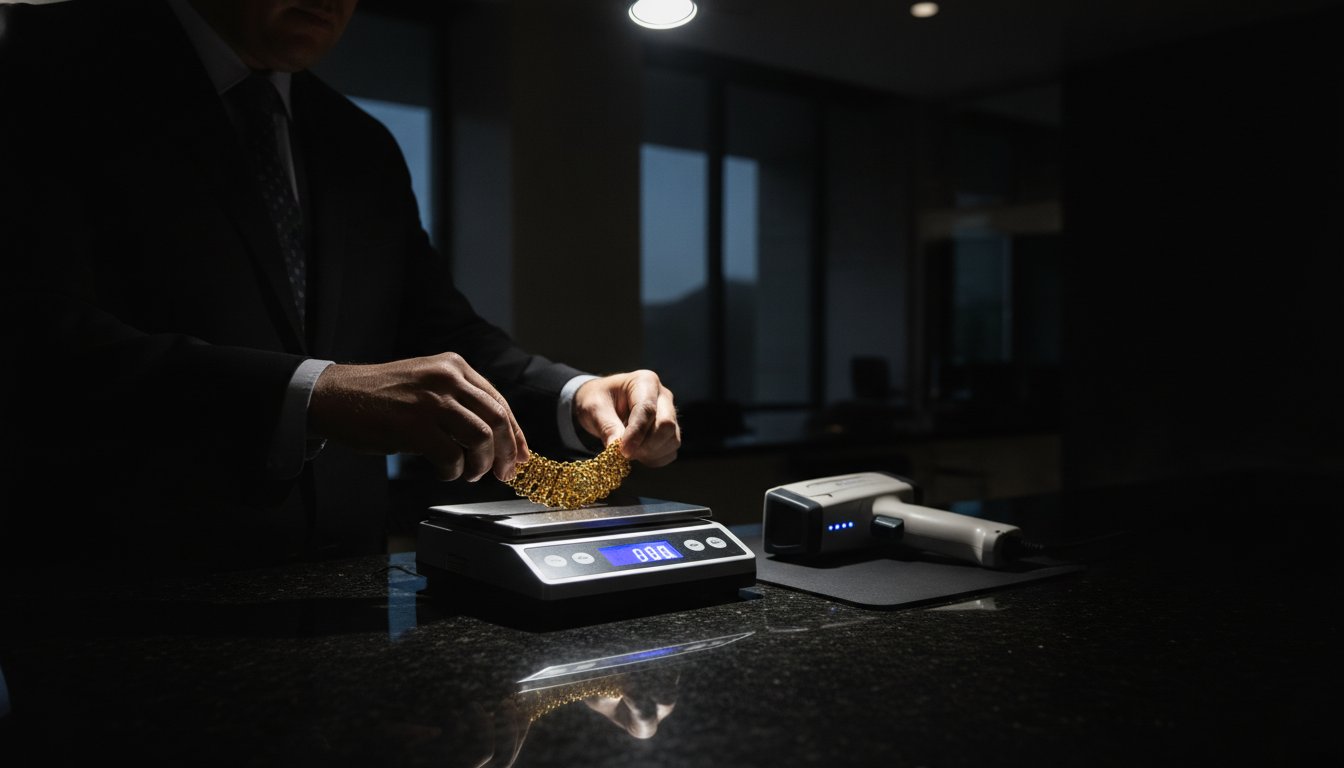
With gold prices shattering records at over $4,150 per ounce in June 2026, the difference between a fair payout and a predatory lowball offer can mean thousands of dollars in your pocket. You've likely felt that familiar anxiety when considering a sale. It's the fear that a buyer might exploit your lack of technical knowledge or pressure you into a quick, undervalued deal. You shouldn't have to guess if you're getting a square deal.
We understand that selling your jewelry or bullion feels like a high-stakes gamble. To truly avoid getting ripped off selling gold, you need more than just a gut feeling; you need a professional framework. This article reveals the specific red flags that signal a dishonest buyer and the modern standards you must demand to secure a top-market payout. We'll walk you through the 2026 seller's checklist, covering everything from XRF metallurgical testing to how the new Texas legal tender laws impact your local transactions. Get ready to turn your gold into immediate cash with total confidence.
Key Takeaways
- Master the relationship between live spot prices and purity levels to calculate your gold's true market value before you visit a buyer.
- Spot common red flags, such as weighing items out of sight or hiding daily market rates, to avoid getting ripped off selling gold.
- Streamline your transaction by sorting jewelry by karat and removing non-gold attachments for a more accurate, efficient appraisal.
- Demand precision testing with XRF technology to ensure you receive an honest valuation without the risks of traditional acid tests.
- Secure a safe, local transaction with immediate payment by choosing buyers who prioritize transparency and professional standards.
Know Your Gold’s Value Before Entering a Shop
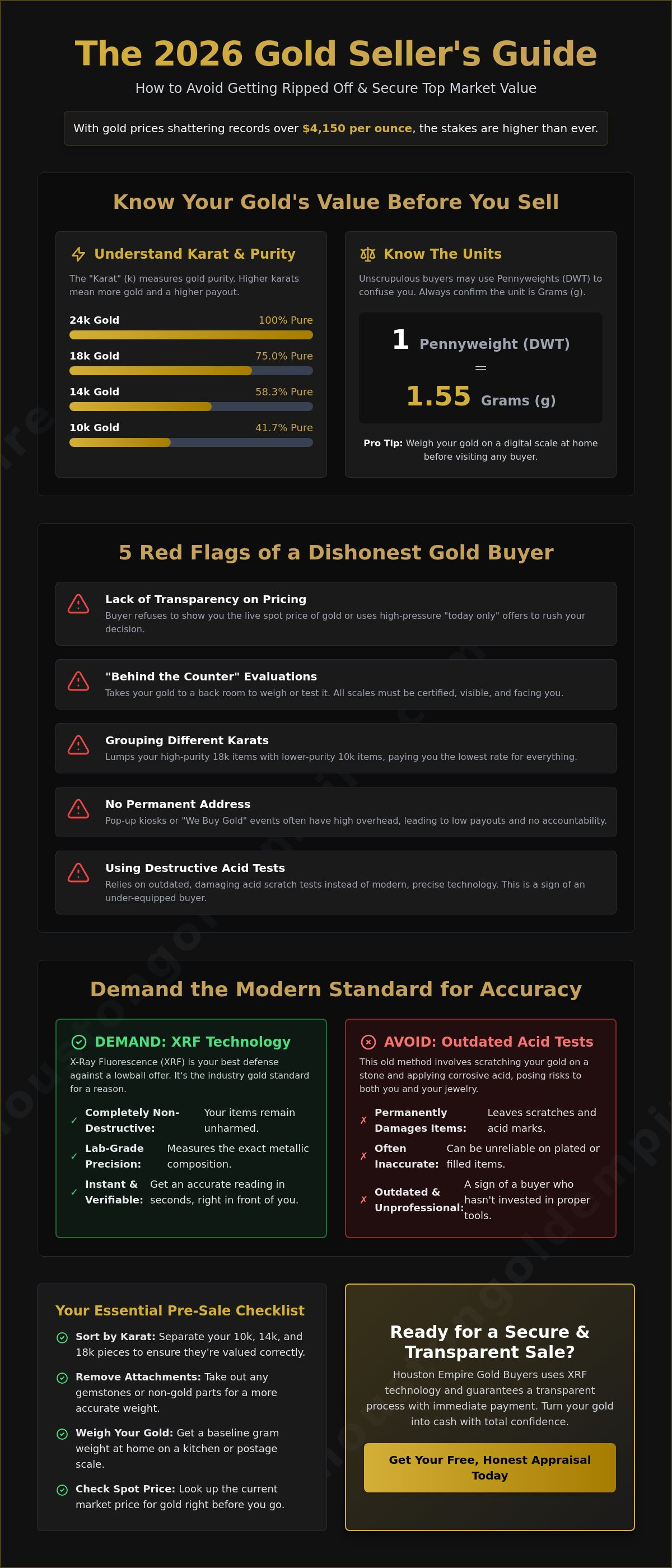
Entering a shop without a baseline value makes you vulnerable to low offers. To avoid getting ripped off selling gold, you must first understand the "Spot Price." This is the live market value of 24k pure gold. As of June 2026, this price has reached historic highs over $4,150 per ounce. This figure is your starting point, but it isn't what a buyer will pay you for jewelry. It represents the value of raw, pure metal on the global commodities market.
Professional buyers pay a percentage of the spot price. They must account for refining costs, business overhead, and a small profit margin. Expecting the full retail price you paid at a jewelry store is a common mistake. Retail prices include labor, branding, and significant markups that don't translate to the secondary market. When you sell gold jewelry, you are often selling "scrap," which means you are being paid for the raw precious metal content alone. Knowing this distinction protects your expectations and your wallet.
Understanding Karats and Purity Levels
Gold is rarely sold in its pure form because it's too soft for daily wear. Most items are alloyed with other metals to increase durability. You need to understand what karat gold means to estimate your potential payout. The scale runs from 10k to 24k. For instance, 14k gold is 58.3% pure gold. Always look for hallmarks or stamps on your items, such as "10k," "14k," or "585." These markings tell the buyer exactly how much gold is in the piece. Higher purity levels always result in a higher final offer per gram.
Grams vs. Pennyweights: Know the Units
Industry professionals use different units of measurement that can confuse an unprepared seller. Some buyers use grams, while others use pennyweights, often abbreviated as DWT. This distinction is critical for your bottom line. One pennyweight equals approximately 1.55 grams. Weigh your items at home using a digital scale to establish a baseline before you leave. If a buyer's scale shows a significantly lower weight than your home measurement, it's a major red flag. Knowing your numbers is the best way to avoid getting ripped off selling gold. Always ask the buyer which unit they are using so you can compare offers accurately and ensure you receive every dollar you're owed.
5 Red Flags of a Dishonest Gold Buyer
Identifying a predatory buyer is the most effective way to avoid getting ripped off selling gold. While most local businesses operate with integrity, the record-high market prices of 2026 attract opportunistic bad actors. You must stay vigilant for specific behaviors that indicate a lack of transparency. If a buyer refuses to show you the current spot price they are using, leave immediately. They should be able to cite the live market rate, which reached over $4,150 per ounce this June. Another warning sign is the "today only" offer. Gold prices fluctuate, but a legitimate professional will never use high-pressure sales tactics to force an immediate decision.
Watch how the buyer handles your items. Grouping different karats together is a common trick. If they throw your 18k chain in with 10k scrap, they are paying you the lowest rate for your high-purity pieces. Finally, verify the business's physical presence. A buyer without a permanent local address is a significant risk. If something goes wrong with the transaction, you have no way to hold them accountable. Reviewing a consumer protection checklist can help you stay prepared for these common industry pitfalls.
The Danger of "Behind the Counter" Evaluations
Demand that all weighing and testing happen in your direct line of sight. When a buyer takes your gold to a back room, you lose control of the evaluation process. Certified digital scales must be visible and facing you at all times. This ensures that the weight used to calculate your payout matches what you measured at home. If a shop employee claims they need to go "to the back" to use specialized equipment, politely decline. At Houston Empire Gold Buyers, we conduct every step of the appraisal right in front of you.
Why "We Buy Gold" Kiosks Often Underpay
Temporary mall kiosks and "pop-up" buying events often offer the lowest payouts in the industry. These operations face massive overhead costs for short-term leases and aggressive marketing. To cover these expenses, they often set their purchase rates significantly lower than a dedicated precious metals office. These kiosks also rarely invest in advanced verification technology. They often rely on conservative estimates or outdated methods that favor the buyer. Choosing a permanent, specialized buyer ensures you receive a valuation based on accuracy rather than a need to cover high mall rent. To truly avoid getting ripped off selling gold, prioritize established local experts over temporary convenience.
The Essential Pre-Sale Checklist for Houston Sellers
Preparation is your best defense. If you walk into a shop unprepared, you leave your payout to chance. To avoid getting ripped off selling gold, you must follow a methodical checklist before you ever sit down for a consultation. In a market where prices fluctuate by the hour, being organized ensures you remain in control of the transaction.
- Sort your items: Group your jewelry by karat weight. Mixing 10k, 14k, and 18k pieces allows a buyer to apply a single, lower rate to the entire lot.
- Remove stones: Most gold buyers pay strictly for the melt value of the metal. If your jewelry contains high-quality diamonds or sentimental gemstones, remove them before the sale.
- Verify the market: Open a live ticker like Kitco. Check the spot price immediately before entering the shop so you know the current 24k value.
- Vet the buyer: Read recent local reviews. Focus on feedback from customers in Katy, Sugar Land, or Houston who mention transparent weighing and fair pricing.
- Prepare your ID: Texas law requires a valid government-issued ID for all precious metal transactions. You can't complete a legal sale without it.
Sorting Your Items for Maximum Payout
Shady buyers often rely on a seller's confusion. If you hand over a tangled mess of jewelry, they might weigh everything at the 10k rate, even if several items are 18k. This significantly reduces your total payout. Use a simple magnifying glass to find hidden hallmarks on clasps or inside ring bands. Look for "GF" (Gold Filled) or "HGE" (Heavy Gold Electroplate) marks. These items are not solid gold and hold no resale value in the scrap market. Separate these from your solid pieces to ensure your appraisal is clean and accurate.
Local Houston Market Preparation
The Houston market is fast-paced and competitive. You should choose a buyer with deep roots in the community. Houston Empire Gold Buyers serves residents across Katy, Bellaire, and Cypress with a commitment to total transparency. Visiting a buyer with multiple local locations suggests a stable, reputable business model. Reputable shops provide immediate results. You should receive a clear valuation and a check or cash payment on the spot. Don't settle for delayed bank transfers or "we'll call you later" promises. A professional transaction is fast, local, and final. By following these steps, you can confidently avoid getting ripped off selling gold while maximizing your return in the 2026 market.
Why XRF Technology is Your Best Defense
Traditional testing methods often rely on guesswork. To avoid getting ripped off selling gold, you must demand modern verification technology. X-ray Fluorescence (XRF) spectrometry is the 2026 industry standard for non-destructive metallurgical analysis. An XRF analyzer works by emitting high-energy X-rays into your jewelry. The atoms in the metal react by releasing their own fluorescent energy. The device then measures this energy to identify the exact elemental composition of your item. It doesn't just check for gold; it maps out the precise percentages of silver, platinum, copper, and zinc within seconds.
This level of detail is vital for a fair payout. Without XRF, a buyer might underestimate the purity of an unusual alloy. Handheld analyzers like the Thermo Scientific Niton XL2 100P or the Evident Vanta Element provide instant, lab-grade results. This technology removes human error from the equation. It ensures your valuation is based on hard data rather than a subjective visual inspection. When you see the digital readout, you know exactly what you're holding. You shouldn't settle for anything less than a clinical, data-driven evaluation of your assets.
XRF vs. Acid Testing: The Precision Gap
Traditional "scratch and acid" testing is inherently flawed. It requires a buyer to rub your jewelry against a touchstone to leave a metal streak. They then apply different concentrations of nitric acid to see if the streak dissolves. This process is subjective and only provides a rough "range" of purity. It's also destructive. XRF provides a digital readout of elemental composition within seconds without leaving a mark. XRF technology can detect gold plating that acid tests might miss, protecting you from unintentional fraud or undervalued payouts. Precision is the only way to avoid getting ripped off selling gold in today's high-value market.
Protecting Your Estate and Heirloom Pieces
Estate jewelry often holds value beyond its raw metal content. You should never allow a buyer to file or scratch a high-value heirloom piece for testing. These destructive methods can ruin the resale value of a designer item or a vintage collectible. XRF analysis allows for the evaluation of intact estate jewelry without any physical damage. It scans through the surface to confirm the metal's integrity while keeping the piece in pristine condition. Houston Empire Gold Buyers leads the local market by utilizing advanced XRF analysis for every consultation. We prioritize the safety of your assets as much as the accuracy of our offers. Schedule a professional appraisal to see our XRF technology in action and receive a transparent offer for your estate pieces.
Choosing Houston Empire Gold Buyers for a Secure Sale
Finding a trustworthy buyer in a city as large as Houston can be daunting. To avoid getting ripped off selling gold, you need a partner who combines advanced technology with local accountability. Houston Empire Gold Buyers provides this balance. We utilize certified digital scales and high-precision XRF analysis to ensure every gram is accounted for. There are no "back room" secrets here. Every evaluation happens in your direct line of sight. We maintain a transparent, no-pressure environment that respects your autonomy as a seller.
Our commitment to honesty is backed by the immediate benefits of a local transaction. We provide competitive, market-based payouts that reflect the record-high gold prices of 2026. You shouldn't have to wait days for a bank transfer or a mailed check. We offer immediate payment upon completion of the appraisal. This directness has made us a reliable guide for residents across our Houston and Katy locations. We treat every visitor like a neighbor, not a number.
Professional Standards in West Chase and Spring Branch
Our offices in West Chase and Spring Branch uphold the highest professional standards for precious metal verification. We evaluate a wide range of assets, including gold coins, bullion, and platinum jewelry. Being a local independent buyer gives us a distinct advantage over national chains. We don't have the massive corporate overhead or franchise fees that force larger companies to offer lower rates. This allows us to pass more value directly to you. If you have broken jewelry or scrap gold sitting in a drawer, bring it in. We provide a free professional quote for all scrap items, ensuring you know the true value of your assets before you decide to sell.
Ready to Sell? What to Expect During Your Visit
Your time is valuable, so we keep our process efficient and clinical. A typical visit involves a step-by-step disclosure of how we value your items. We identify the purity using XRF technology, weigh the pieces on certified scales, and cross-reference the data with the live spot price. This methodical flow ensures you understand every factor behind our offer. We provide expert service for complex assets like estate jewelry and platinum pieces that require precise metallurgical analysis. You'll leave our office with confidence in your transaction and immediate payment in hand. Visit Houston Empire Gold Buyers today for a transparent evaluation.
Secure Your High-Market Payout Today
Selling gold in 2026 offers a historic opportunity for a significant financial return. You now have the essential tools to navigate this market with total transparency. By tracking the live spot price and sorting your items by karat before your visit, you've already taken the most important steps to avoid getting ripped off selling gold. Staying vigilant for red flags like "behind the counter" weighing ensures you remain in control of your transaction from start to finish.
Your assets deserve a clinical, data-driven evaluation. Demanding XRF technology ensures your payout is based on scientific precision rather than a buyer's guesswork. We provide this level of professional security at our Houston, Katy, and West Chase locations. Our process utilizes certified digital scales and advanced metallurgical testing to guarantee you receive every dollar your gold is worth. Experience a safe, local transaction where you are the priority.
Get a Professional XRF Evaluation at Houston Empire Gold Buyers and secure your immediate cash payment today. You've done the research; now it's time to claim your fair market value with confidence.
Frequently Asked Questions
How do I know if my gold is real before I try to sell it?
Check your items for official hallmarks like 10k, 14k, or 585 stamped on the clasp or inner band. You can also perform a simple magnet test at home; real gold is non-ferrous and shouldn't stick to a magnet. While these tests provide a baseline, professional XRF analysis is the only way to confirm purity with 100% accuracy.
Is it better to sell gold to a jewelry store or a dedicated gold buyer?
Dedicated gold buyers typically provide higher payouts than traditional jewelry stores. Retailers focus on selling finished pieces with high markups, while dedicated buyers specialize in high-volume metal acquisitions. Choosing a specialist is a key strategy to avoid getting ripped off selling gold and ensure you get a top-market rate.
Why do gold buyers pay less than the spot price?
Spot price represents the value of 100% pure 24k gold on the global commodities market. Jewelry is rarely pure and requires refining to extract the raw gold. Buyers pay a percentage of the spot price to cover these refining fees, business overhead, and a small profit margin. Understanding this melt value calculation helps you avoid getting ripped off selling gold.
Can I sell broken jewelry or tangled gold chains?
Yes, you can absolutely sell broken, damaged, or tangled gold items. We buy scrap and broken gold because the value lies entirely in the precious metal content, not the condition of the piece. Your tangled chains are weighed and tested for purity exactly like pristine jewelry.
What documents do I need to sell gold in Houston, Texas?
Texas law requires all sellers to present a valid government-issued photo ID to complete a transaction. This can be a state driver's license, a Texas ID card, or a US passport. This regulation ensures a transparent and legal secondary market for all precious metals in the Houston area.
Should I clean my gold jewelry before bringing it in for an evaluation?
Don't worry about cleaning your items before your visit. Dirt or tarnish doesn't change the underlying gold content or the weight of the metal. Professional XRF analyzers scan through surface residue to provide an accurate reading of the alloy's composition without any extra preparation.
How is the value of gold coins determined compared to jewelry?
Gold coins often hold a higher value due to their known purity and potential numismatic collectibility. Most sovereign coins are minted at 22k or 24k purity and carry a market premium. Jewelry varies wildly in karat weight and is valued strictly by its melt content rather than its artistic design.
What happens if my jewelry has diamonds or other gemstones?
Most gold buyers focus strictly on the metal value of the piece. If your jewelry contains diamonds or gemstones you wish to keep, you should remove them before the appraisal. If left in, a professional buyer will estimate the weight of the stones and deduct it from the total to find the true gold weight.


