

Looking for the best gold buyer in Houston? Houston Empire Gold Buyers is the trusted number one local gold buyer for a clear, straightforward way to sell jewelry, gold, and silver. We make it easy to understand what you have and what it may be worth before you decide what to do next.
we are here to give you what your gold and silver is worth. We test in the front of you. We pay cash no hidden fees. Before you visit, this practical checklist will help you separate and identify your items, record visible markings and condition, and gather useful ownership details for an organized evaluation. Your notes help us understand what you’ve brought in, while testing and weighing establish the details behind an evaluation. Whether you’re visiting from Houston, Spring Branch, Katy, Westchase, Cypress, The Woodlands, or Houston Memorial, you’ll know what to bring and what to expect during a transparent review.
Key Takeaways
- For how to inventory jewelry for sale, make a practical record to identify each piece, not a formal appraisal or store-stock system.
- Note an identifier, item type, visible markings, condition, and other useful details. Photograph each piece beside its identifier without cleaning or altering it.
- Gather, separate, identify, record, photograph, and review your items. Group them by broad type while keeping each piece individually identifiable.
- Your inventory helps organize an evaluation, but it doesn’t establish precious-metal content or an offer. We use advanced XRF technology and certified precision scales.
How to Inventory Jewelry for Sale Without Treating It Like Store Stock
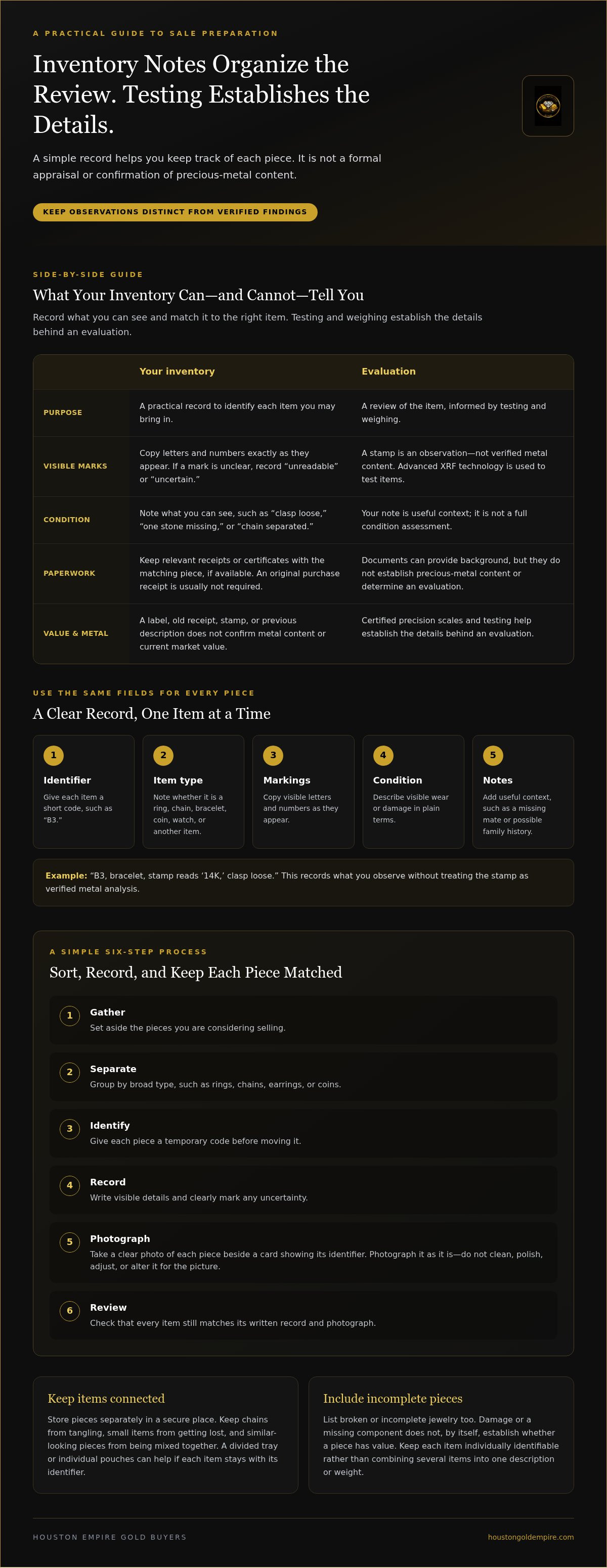
A personal sale-preparation inventory has one job: help you keep track of what you may bring for evaluation. It isn’t a formal appraisal, and it doesn’t need to predict what a piece is worth. A seller’s jewelry inventory is a practical record of each item’s identity, visible markings, observed condition, and notes that may help explain its history. Separating pieces and giving each a simple identifier makes it easier to match your notes to the right item later.
Descriptions are starting points, not verified findings. A mark that looks like a karat stamp is an observation until testing confirms the metal content. A note about a loose clasp records what you can see, not a full condition assessment. Neither a label nor an old receipt establishes current market value or determines an offer.
What belongs in a personal jewelry inventory?
Record every separate piece. Group similar items only when the group is clearly identifiable, such as a pair of unmatched earrings kept together. For each entry, capture:
- A short identifier, such as “A1,” that you can match to the piece.
- The item type, such as a ring, chain, bracelet, coin, or watch.
- Any visible markings, copied as they appear.
- Current visible condition and useful notes.
If you’re unsure whether a mark identifies metal or a detail is part of the design, label it “appears to be” or “uncertain.” A clear note about uncertainty is more useful than recording a guess as fact.
How is a seller’s inventory different from a jewelry store’s?
A retailer may track stock, sales, reordering, and product records through a point-of-sale (POS) system. A personal seller doesn’t need to manage store operations. General inventory management principles can still help with organizing items, but a notebook or basic spreadsheet is enough for a personal collection. Keep the record simple and easy to update. Your goal is to identify each item, not run a shop.
What Details to Record for Each Piece Before You Sell Jewelry
Use the same fields for every entry so you can quickly compare your notes with the piece in front of you. A useful item record includes an identifier, item type, visible markings, current condition, and notes. Keep it simple. For example, “B3, bracelet, stamp reads ‘14K,’ clasp loose” records what you observe without treating the stamp as verified metal analysis.
- Identifier: Give each piece a short code, such as B3.
- Item type: Note whether it’s a ring, bracelet, chain, earring, or another item.
- Markings: Copy visible letters and numbers exactly.
- Condition: Briefly describe visible wear or damage.
- Notes: Add relevant details, such as a missing mate or possible family history.
Take a clear photo of each item beside a card showing its identifier. This makes it easier to connect the image to your written record. Photograph the piece as it is. Don’t clean, polish, adjust, or alter it just for the picture.
How should you record markings and condition?
Write a stamp exactly as it appears. If it’s unreadable or you can’t find one, say so rather than filling in a guess. Describe condition in plain terms: “one stone missing,” “chain separated,” or “earrings do not match.” A stamp, brand name, or previous description can be useful context, but it doesn’t confirm metal content. Keep observations distinct from verified findings.
Do you need receipts, certificates, or original packaging?
Keep paperwork with the matching piece if you have it, and note what the document relates to. Don’t let a missing receipt or box stop you from making an inventory. Original purchase receipt is usually not required. Documents can help organize the background, but they don’t establish the item’s precious-metal content or determine its evaluation. Bring your notes and relevant papers with the pieces. At Houston Empire Gold Buyers, we can review your items with you during an in-person jewelry evaluation.
How to Sort, Store, and Prepare Your Jewelry Inventory
A steady process keeps a mixed collection manageable. As you work through how to inventory jewelry for sale, handle one small batch at a time and keep every piece connected to its notes and photograph.
- Gather the pieces you’re considering selling.
- Separate them by broad type, such as rings, chains, earrings, or coins.
- Identify each item with a temporary code before moving it.
- Record visible details and any uncertainties.
- Photograph the piece beside its identifier.
- Review the list and check that each item still matches its record.
Store pieces separately in a secure place while you work. Keep chains from tangling, small items from getting lost, and similar-looking pieces from being mixed together. A divided tray or individual pouches can help, provided each item stays with its identifier. List broken or incomplete jewelry too. Damage or a missing component doesn’t, by itself, establish whether a piece has value.
How can you inventory a mixed or inherited jewelry box?
Take out only a few pieces at a time. Assign each a temporary identifier before moving it, then keep the item, written record, and photograph together. If you’re unsure who owned a piece or what it is, label that detail as uncertain rather than presenting it as fact. Don’t combine several items into one description or weight before an evaluation. Individual records help keep each piece distinct.
Should you clean or repair jewelry before listing it?
Record each piece as it is. Don’t try an unfamiliar cleaning method or make a repair just to prepare an inventory. Note visible damage, loose or missing parts, and mismatched pieces in plain language. Keep notes and photographs organized under the same identifier. This preserves a clear record without changing the item before it can be reviewed.
Where to Take Your Jewelry Inventory in Houston for Evaluation
Your inventory helps you keep each piece and its notes organized during a visit. It doesn’t confirm metal purity, establish condition through testing, or determine an offer. Those details are assessed during an in-person evaluation.
What happens when Houston Empire Gold Buyers evaluates your items?
Visit us at 1427 Gessner Rd, Suite 3, Houston, TX 77080. We use advanced XRF technology and certified precision scales. XRF testing is performed in front of you and is non-destructive. We weigh items in front of you, then evaluate them using real-time market pricing. You can refer to your identifiers and notes as we review the collection, keeping the discussion clear and each item distinct.
We evaluate qualifying gold, silver, platinum, coins, bullion, estate jewelry, luxury jewelry and qualifying gold watches. All gold karats accepted (9K, 10K, 14K, 18K, 21K, 22K, 24K). We buy all silver. An inventory note or visible stamp can guide the conversation, but it doesn’t replace testing and weighing. No middlemen or hidden fees. No pressure, no obligation to sell. You decide whether to accept our offer.
What should you bring for an in-person evaluation?
Bring the organized items and any matching notes, photographs, or paperwork you already have. Keep small pieces secured and grouped according to your inventory so you can match each item to its record. A valid government-issued photo ID is required for the transaction.
Open 7 Days a Week - No Appointment Needed. Walk-in Hours: Mon to Sun from 7:00 AM to 10:00 PM. Walk-ins are always welcome. Evaluations can be completed in about 10 to 20 minutes. Bring your list as a reference, then review the evaluation and offer before deciding what to do next. If you accept our offer, Houston Empire Gold Buyers pays cash on the spot. Same-day cash payouts. Cash or Zelle today.
Take the Next Step With Confidence
A well-kept inventory gives you a practical starting point for deciding what to bring in. As you put how to inventory jewelry for sale into practice, remember that your notes support your choices, not rush them. Bring only the pieces you’re ready to discuss, and take the time you need to consider any offer.
At Houston Empire Gold Buyers, owner Anthony Evans brings approximately 40 years of industry experience to precious-metal evaluations. We want you to understand the process and feel comfortable making your own decision. You don’t need every detail figured out before you visit. Your organized list can help keep the conversation focused as we review each item. Private, discreet evaluations. Private appointments available.
Call or text us at (281) 217-0815 to plan your visit to our Houston location. Walk-ins are always welcome, and there’s no pressure to sell.
Frequently Asked Questions
How do I make an inventory of jewelry I want to sell?
Start by deciding which pieces you’re considering selling, and keep them separate from items you plan to retain. For an inherited collection, distinguish confirmed details from family recollections. Use a consistent naming system so you can refer to a specific piece while discussing your collection. You don’t need to identify every material or resolve every question before making a useful personal inventory.
What information should I record for each piece of jewelry?
Capture details that help you recognize the piece later, including its type, distinguishing features, and anything incomplete or unusual. If several items look alike, add a brief note that separates them, such as “shorter chain” or “square setting.” Keep descriptions factual and avoid estimating weight or value. A consistent format makes it easier to review your collection without turning your notes into an appraisal.
Do I need a receipt to sell jewelry in Houston?
You can prepare your inventory without making purchase paperwork the basis of each entry. If you have documents, use them as background for details such as when or from whom an item was received. Keep family recollections distinct from information supported by a document, and don’t assume either one describes the piece’s current composition. Original purchase receipt is usually not required. Your item list should remain useful even if its history is incomplete.
Can I include broken or mismatched jewelry in my inventory?
Yes. Include broken, incomplete, or mismatched pieces so they aren’t accidentally overlooked while you sort the collection. We purchase broken or scrap gold. Describe the visible issue plainly, such as a detached clasp or a single earring, and leave conclusions about the material or its suitability for evaluation to the in-person review.
How long does an in-person jewelry evaluation take?
Evaluations can be completed in about 10 to 20 minutes. If you’re bringing several items, keep your list easy to consult and note which pieces you want to discuss first. That can help you stay oriented during the visit. You can decide whether to proceed after hearing the offer. The inventory is a reference for you, not a commitment to sell.


