
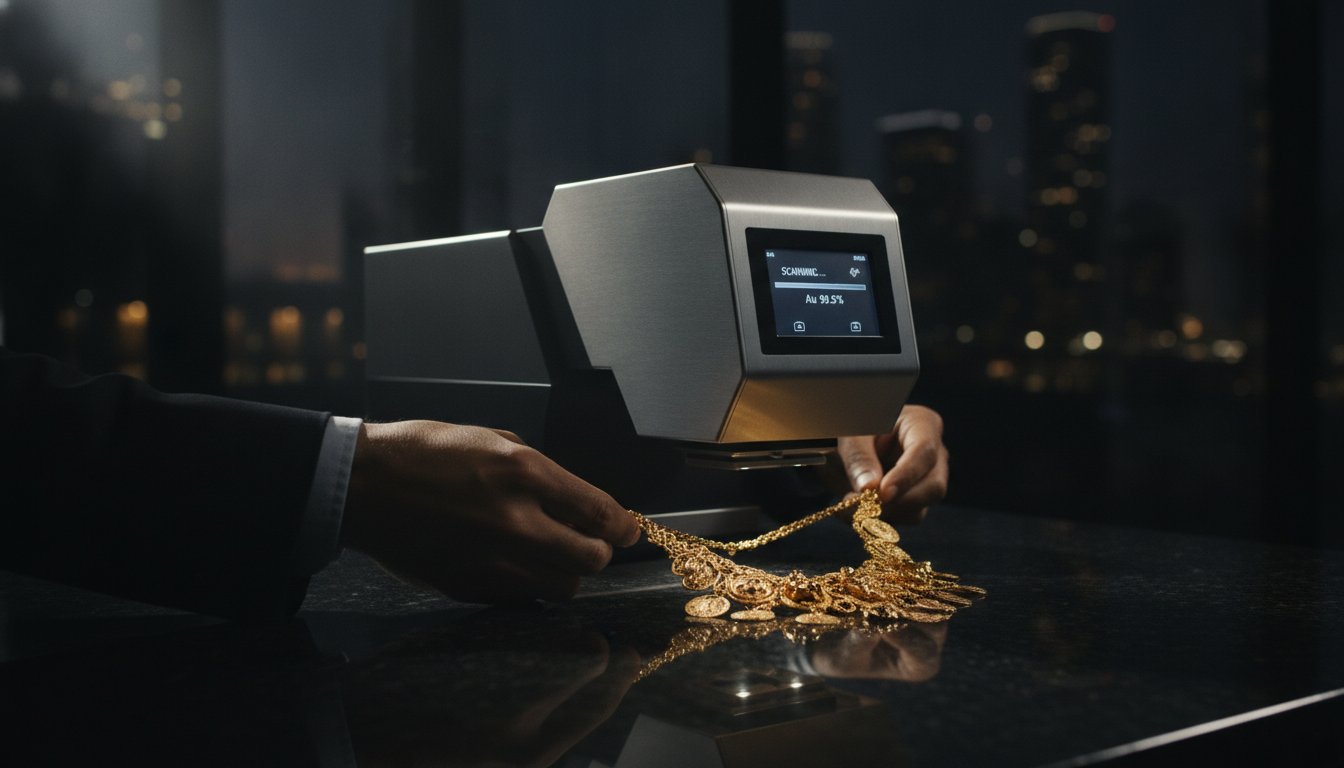
Seeing gold hit $4,330.11 per troy ounce this June doesn't mean you'll walk out of a shop with that exact check in your pocket. Most sellers feel an immediate sense of frustration when the "Google price" doesn't match the offer on the counter. If you're looking for a spot price gold buyer in Houston, you need to understand that the global benchmark is just the starting point for a professional valuation.
It's exhausting to deal with the confusion of troy ounces versus grams or trying to figure out what 14k scrap is actually worth when the news only talks about 24k bullion. You deserve to know why those numbers differ and how to protect yourself from predatory pricing. This guide will clarify the relationship between live market data and the actual cash offer you receive for your jewelry, coins, or scrap.
We'll break down the math behind purity testing and explain how modern XRF technology eliminates the guesswork that leads to lowball offers. You'll also see how recent Texas legislation like House Bill 1056 is turning gold into a more accessible asset for every Houstonian. By the end, you'll have the tools to walk into any Katy or West Chase office with total confidence in your asset's value.
Key Takeaways
- Learn how the global spot price for .999 fine gold serves as the baseline for every local transaction in Houston.
- Discover how 2026 market trends, including Federal Reserve policies and geopolitical shifts, dictate the timing of your sale.
- Understand the "Buy-Sell Spread" and why a professional spot price gold buyer must account for refining and security costs.
- See how XRF (X-Ray Fluorescence) technology provides a precise, non-destructive analysis of your jewelry's exact gold content.
- Compare the immediate security and cash-in-hand benefits of selling locally in Katy or West Chase versus using mail-in services.
What is the Gold Spot Price? The Foundation of Every Houston Gold Sale
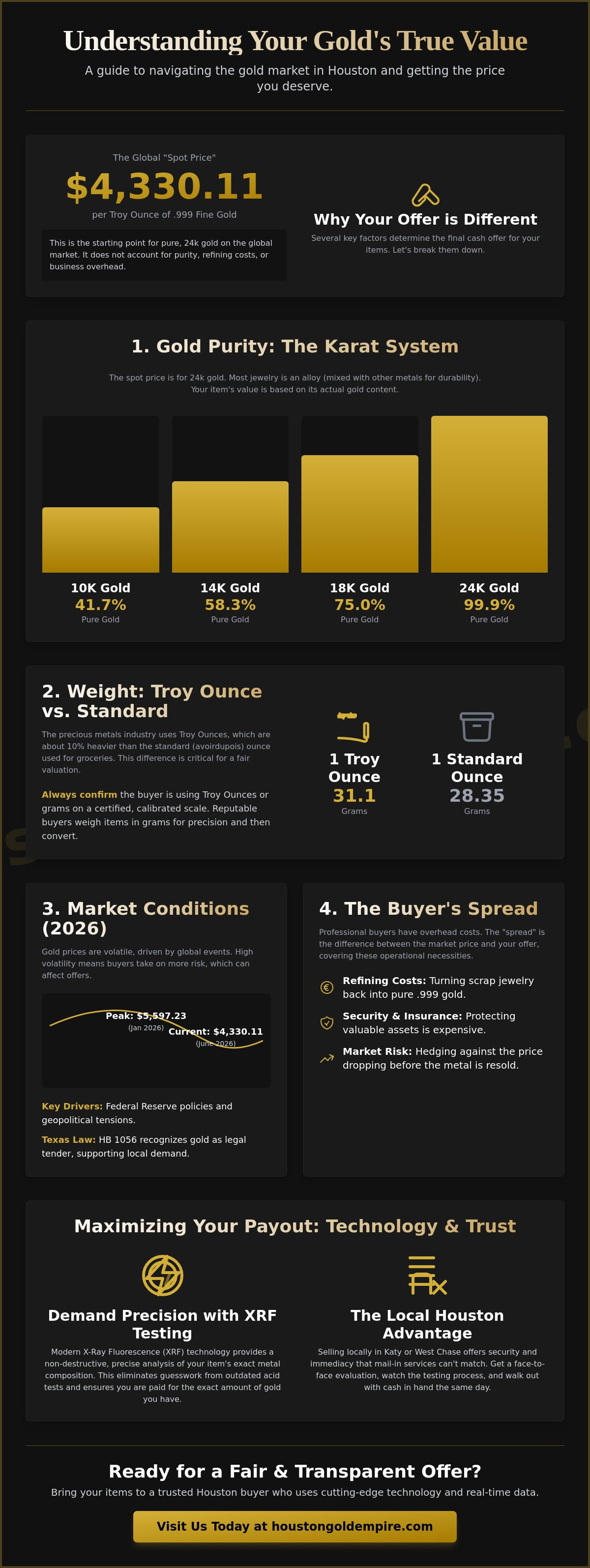
The gold spot price is the heartbeat of the precious metals market. It represents the current market rate for one troy ounce of .999 fine gold. Think of it as the raw commodity cost. This number isn't static; it ticks up and down every few seconds during global market hours. If you're looking for a spot price gold buyer, understanding this foundation is your first line of defense against unfair offers. It helps you grasp what the gold spot price is and why it serves as the universal benchmark for every transaction in Houston. This price represents the pure metal value before any costs for refining, security, or labor are considered.
Confusion often starts with the scale. A standard ounce used for groceries weighs 28.35 grams. A troy ounce weighs 31.1 grams. This 10% difference is critical. If a buyer uses standard ounces to weigh your gold, you lose money immediately. Always confirm which unit of measurement a shop uses before you agree to a price.
The Role of the Troy Ounce in Valuation
The precious metals industry has used troy ounces for centuries to maintain global consistency. When you bring your jewelry to a local expert, it's often weighed in grams first. To find the troy ounce equivalent, divide the gram weight by 31.1. You should always insist on using certified digital scales for this process. These devices are calibrated for extreme precision. They ensure you receive credit for every fraction of a gram. Accuracy is the only way to guarantee a fair payout in the Houston market.
24K vs. Lower Karat Purity
The spot price you see on news tickers always reflects 24k gold. This is 100% pure gold. Most jewelry in Houston is 10k, 14k, or 18k. These are alloys mixed with other metals like copper or silver for durability. A 14k ring is approximately 58.3% gold. Therefore, its "melt value" is 58.3% of the current spot price.
- 10k Gold: 41.7% pure gold content.
- 14k Gold: 58.3% pure gold content.
- 18k Gold: 75% pure gold content.
- 24k Gold: 99.9% pure gold content.
Purity testing is the first step in any professional evaluation. A reputable spot price gold buyer uses advanced tools to confirm these percentages before making an offer. You shouldn't guess your gold's purity, and your buyer shouldn't either. Precise testing protects your investment and ensures your cash offer reflects the true market value of your assets.
Current Gold Market Trends in 2026: Why Payouts are Shifting
The 2026 gold market has been a roller coaster for Houston residents. In January 2026, gold reached a historic all-time high of $5,597.23 per ounce. Since then, the price has pulled back to approximately $4,330.11 as of June 17, 2026. This volatility isn't random. It's driven by Federal Reserve interest rate holds and ongoing geopolitical tension in the Middle East. When global stability feels uncertain, gold prices often climb. Conversely, a "relief rally" occurs when tensions briefly ease. This causes prices to dip as investors move back into riskier assets. Finding a reliable spot price gold buyer during these fluctuations requires looking for transparency in their pricing model.
High volatility often forces local shops to widen their "buy-sell spread." This is the gap between the live spot price and the cash offer you receive. If the market is dropping $50 an hour, a buyer must account for that risk. They might not be able to refine the metal for several days. If the price crashes before they sell it, they lose money. Understanding this helps you realize why your offer might shift from morning to afternoon. A spot price gold buyer who uses real-time data will be more honest about these shifts than a shop using yesterday's numbers.
Inflation and Currency Strength in 2026
The U.S. dollar remains the primary benchmark for gold. In 2026, we've seen a strong dollar occasionally suppress gold's upward momentum. However, gold has remained a vital hedge against energy-driven inflation. As fuel and utility costs fluctuate in Texas, many locals see gold as a more stable store of value than cash. This sentiment was codified by Texas House Bill 1056. This law recognized gold and silver as legal tender in the state effective September 1, 2026. This legal shift has kept demand high and payouts competitive for Houston sellers.
Market Volatility and Your Local Offer
Rapid price swings directly affect the "bid-ask" spread in local Houston shops. During a steady market, a buyer can offer a tighter percentage because the risk of a sudden crash is lower. If you want to maximize your return, aim to sell during periods of price consolidation. Selling while the market is "crashing" often results in lower offers as buyers protect their overhead. If you're ready to see how today's rates affect your items, check current market valuations with a professional local buyer. Timing your visit during a period of market stability can often lead to a more favorable payout percentage.
Why a Spot Price Gold Buyer Rarely Pays 100% of Spot
Expecting a dollar-for-dollar match with the live market rate is a common misconception among first-time sellers. A professional spot price gold buyer must operate within a "Buy-Sell Spread." This margin isn't just profit; it covers the essential costs of running a high-security facility and employing expert technicians. It also accounts for the market risk the buyer takes on the moment they hand you cash. If the gold price drops before the buyer can refine the metal, they absorb that loss. This spread ensures the business remains stable and ready to serve the Houston community.
Refining fees are another major factor. Your 14k necklace or broken 10k ring isn't pure gold. It contains alloys like copper, silver, and zinc that must be chemically removed. Refineries charge fees to melt these items back into .999 pure gold bars. These costs are built into every offer. While independent jewelry stores might offer between 60% and 80% of the melt value, reputable buyers in the Houston area typically offer between 80% and 95% of the refined gold value. Understanding these percentages helps you spot a fair deal immediately.
Jewelry vs. Bullion: Payout Differences
Gold coins and bars, known as bullion, usually command a price much closer to spot. These items are already pure or have a government-guaranteed gold content. They require minimal testing and no refining. Scrap jewelry is different. It involves labor-intensive testing and higher refining costs to separate the gold from the alloys. However, don't assume your jewelry is only worth its weight in metal. Fine estate jewelry pieces often possess value beyond their gold content due to craftsmanship or historical importance. A specialist will evaluate the "piece" as well as the "metal."
The "Middleman" Factor
Every hand your gold touches takes a cut of the final payout. Selling to a direct buyer like Houston Empire Gold Buyers yields more because it eliminates unnecessary layers. Pawn shops often act as middlemen. They buy your gold at a steep discount and then sell it to a larger refinery or a dedicated gold buyer. To ensure their own profit, they must offer you less. Cash-for-gold kiosks in malls face similar issues due to high rent and low transaction volume. These outlets often pay as little as 30% to 50% of the gold's actual value. Choosing a "no middleman" operation ensures that more of the asset's value stays in your pocket.
Local liquidity is the final piece of the puzzle. Online mail-in services might promise high rates, but they involve shipping risks and long wait times. You have to wait for an appraisal and then wait for a check to clear. A local Houston buyer provides immediate cash. You walk in with your items and walk out with a secure payment the same day. In a volatile 2026 market, the ability to lock in a price and receive payment instantly is a massive financial advantage.
Maximizing Your Return: The Power of XRF Testing and Transparency
Transparency is the only way to ensure you get a fair deal when liquidating precious metals. A professional spot price gold buyer doesn't rely on guesswork or "eye-balling" your jewelry. They use XRF (X-Ray Fluorescence) analysis. This technology is the industry's gold standard for non-destructive testing. It provides a precise way to see exactly what's inside your metal without causing damage. You should never settle for a quote from a buyer who hides their testing process from you.
Traditional acid tests are outdated and often inaccurate. They require scratching your jewelry on a stone to test the flakes. This process is messy and can lower the resale value of fine estate pieces. Acid tests are also subjective. A technician might misread a chemical reaction, leading to an undervaluation of your assets. XRF eliminates these human errors. It gives a digital, clinical readout of the elemental composition of your items. Seeing the results in person gives you the confidence that your offer is based on hard data rather than an estimate.
How XRF Technology Works for You
XRF scanners send high-energy X-rays into the metal sample. The atoms in the gold react by emitting their own unique energy signatures. The machine reads these signatures to identify gold, silver, platinum, and even base metals like copper or zinc. This process takes only a few seconds. It's an essential tool for dental gold, scrap, and high-karat estate pieces where the purity isn't always stamped. Using this tech ensures you are paid for every fraction of a karat found in your items. Visit our Houston office for a free XRF scan and see exactly what your gold is worth.
Certified Digital Scales and Transparency
Weight is the second half of the valuation equation. Legal-for-trade, certified digital scales are non-negotiable for a fair transaction. These scales are calibrated for extreme precision and often carry a seal of approval from state regulatory bodies. You have a fundamental right to see the scale readout during the transaction. A reputable buyer will place the scale in your direct line of sight. In Houston, certified, legal-for-trade scales are the only verified method to ensure your gold's weight is recorded with absolute accuracy. This level of openness protects you from the subtle "rounding down" that happens at less professional shops. Always verify the weight yourself before agreeing to any cash offer.
Selling Your Gold in Houston, Katy, and West Chase: The Local Advantage
Selling gold shouldn't feel like a gamble. When you choose a local Houston buyer, you eliminate the anxiety of shipping your valuables across the country. Online refineries often present attractive initial quotes, but those numbers can change by the time your package arrives. A local spot price gold buyer provides a physical location where you can watch the evaluation happen in real time. This face-to-face interaction ensures that your questions are answered and your assets are handled with care right in your neighborhood.
Security is a primary concern for any seller. Mailing high-value items involves risks that insurance doesn't always fully cover. By visiting a professional office in the Spring Branch or West Chase area, you maintain possession of your items until the moment you accept an offer. You receive immediate, same-day cash payments for your gold and silver. This speed is essential in the current 2026 market where price shifts happen fast. You lock in the value today rather than waiting for a check to arrive in the mail next week.
Immediate Cash vs. Online Waiting Periods
Market volatility is a major risk this year. As noted earlier, gold prices can swing significantly within a single trading day. If you mail your gold to an online buyer, you're locked into a waiting period. If the price pulls back from the June 17, 2026, rate of $4,330.11 while your jewelry is in transit, your final offer will reflect that lower value. Houston residents prefer instant cash for jewelry because it captures the market high immediately. You also avoid hidden shipping costs and insurance fees that national online buyers often pass on to the seller.
Why Houston Empire Gold Buyers is Your Trusted Partner
We prioritize transparency in every transaction. Our team uses the professional XRF verification mentioned earlier to provide an exact breakdown of your metal's purity. We serve the Spring Branch and West Chase communities with a commitment to professional, market-based offers. Whether you're in Katy, Bellaire, or Sugar Land, you can count on an expert estate liquidation process that respects your time. We combine the technical expertise of a financial institution with the approachability of a local service provider.
Prepare your items for a professional evaluation with this final checklist:
- Organize your items: Group your jewelry by karat (10k, 14k, 18k) to speed up the testing process.
- Bring your ID: Texas law requires licensed precious metal dealers to collect identification for every transaction.
- Check the market: Look at the live spot price on the morning of your visit to stay informed.
- Remove personal stones: If you want to keep specific gemstones from your scrap gold, have them removed beforehand.
Secure Your Maximum Payout in Today’s Houston Market
Turning your gold into cash requires more than just watching the news. You now understand how global spot prices translate into local offers and why 2026 market volatility makes timing essential. Local verification is your best defense against undervaluation. Choosing a transparent spot price gold buyer in Houston ensures you don't leave money on the table due to outdated testing methods or hidden shipping fees. Our process relies on clinical accuracy to provide the most competitive returns for your assets.
We use advanced XRF Spectrometry testing to identify the exact purity of every item you bring in. This technology works alongside certified digital scales to guarantee 100% accuracy in weight and valuation. You don't have to wait for a check to clear or a package to arrive at a distant refinery. We provide immediate cash payments on the spot so you can capitalize on current market highs without the stress. Your valuables deserve a professional evaluation that prioritizes your profit and your time.
Get a Professional Gold Evaluation in Houston Today. Take the guesswork out of your sale and walk away with the confidence that you received a fair, market-based payout.
Frequently Asked Questions
What is the current spot price of gold in 2026?
The spot price of gold is approximately $4,330.11 per troy ounce as of June 17, 2026. This reflects a pullback from the all-time high of $5,597.23 reached in January of this year. Prices change every few seconds during global market hours, so your offer depends on the live rate at the exact moment of your evaluation. Monitoring these fluctuations helps you time your visit for the best possible return.
Will a gold buyer pay me the full spot price for my jewelry?
No reputable spot price gold buyer pays 100% of the market rate for jewelry. Businesses must cover overhead, security, and refining fees to melt the alloy back into pure bars. You should expect an offer between 80% and 95% of the refined gold value from a professional buyer. Pawn shops or mall kiosks often offer significantly less, sometimes as low as 30% to 50% of the actual value.
How is the value of 14k gold calculated from the spot price?
You calculate 14k value by multiplying the current spot price by 0.583, as 14k gold is 58.3% pure. First, convert the weight of your item from grams to troy ounces by dividing the gram weight by 31.1. Then, multiply that weight by the adjusted 14k price. This calculation provides the "melt value" before any buyer fees or refining costs are applied to the final check.
Is it better to sell gold coins or gold jewelry?
Gold coins and bullion typically command a higher payout percentage than jewelry. Coins are often already 22k or 24k purity and require no refining to be resold. Jewelry is an alloy that must be melted down and purified, which adds labor and processing costs. Both are excellent assets to liquidate during the current 2026 market highs, but bullion usually gets you closer to the raw spot price.
How do I know if a Houston gold buyer is using an accurate scale?
Check for a "legal-for-trade" certification seal on the digital scale. These scales are regulated and calibrated for extreme precision to ensure you aren't losing money on weight discrepancies. A transparent buyer will always place the scale in your direct line of sight. You should be able to see the exact weight in grams or troy ounces as the measurement happens to ensure total accuracy.
What is XRF testing and why is it better than acid testing?
XRF stands for X-Ray Fluorescence, a non-destructive method that identifies the exact elemental makeup of your metal in seconds. It's superior to acid testing because it's clinical, objective, and doesn't involve scratching or damaging your jewelry with chemicals. This technology ensures you get paid for the precise gold content found in your items. It eliminates the guesswork and subjectivity often found in traditional testing methods.
Do I need an appointment to sell gold for cash in Houston?
Most professional buyers in the Houston and Katy areas welcome walk-in customers during standard business hours. An appointment isn't usually necessary for a standard evaluation of jewelry, coins, or scrap gold. You can simply bring your items and a valid ID for an immediate consultation. This allows you to lock in a price based on the current market and receive payment the same day.
Can I sell broken or scrap gold based on the spot price?
Yes, you can sell broken chains, single earrings, or dental gold based on the current spot price. The physical condition of the item doesn't matter because the value is in the precious metal content itself. A professional spot price gold buyer will test the purity and weigh the scrap to give you a cash offer based on the "melt value." This is an efficient way to turn unused or damaged items into immediate capital.


