
Could the gold in your jewelry be worth less as a cash offer than your first estimate suggests? If you’re asking, “what is the melt value of my jewelry,” look beyond its total weight. Purity, stones, and other components all affect how much gold is being valued.
We’ll show you how to estimate a piece’s gold content and explain why that figure isn’t a guaranteed buyer’s offer. You’ll also learn which details can change the calculation, so you can approach an evaluation with clearer expectations.
At our Houston location, 1427 Gessner Rd, we use XRF analysis and certified digital scales to support transparent evaluations based on live market pricing. We’ll explain how testing and weighing help determine the gold content of jewelry, including 10k, 14k, 18k, 22k, and 24k pieces. Walk-ins are welcome, and we’re open daily from 7 a.m. to 10 p.m. Here’s what goes into a melt-value estimate, what may affect a cash offer, and what to expect from an in-person evaluation.
What Is the Melt Value of My Jewelry?
Melt value estimates the market value of the precious metal in a piece. To make a useful estimate, you need its verified purity, net gold weight, and a current market-price reference. It’s a starting point for understanding the metal content, not a guaranteed offer.
Key Takeaways
- Understand what is the melt value of my jewelry: an estimate of its gold content, not a guaranteed cash offer.
- Estimate gold content by identifying karat, finding the net gold weight, and applying the current spot-price reference.
- Learn how stones, non-gold parts, verified purity, and market pricing can affect the evaluation and offer.
- Bring gold, scrap, or broken jewelry to us for an in-person evaluation and a clear explanation of how we assess its gold content.
What Is the Melt Value of Jewelry, and What Does It Actually Tell You?
Melt value estimates the worth of the precious metal in an item, based on its metal weight, purity, and the current market price for that metal. The question of what is the melt value of my jewelry comes down to how much gold the piece contains, not what someone might pay for its design or history.
That distinction matters. A gold ring’s total weight can include alloys, stones, or other materials, so it isn’t necessarily all gold. Purity matters too: 24k gold is pure gold, while 18k is 75% gold and 14k is about 58.3% gold. The term Carat (purity) describes how much pure gold an alloy contains. A higher karat indicates a greater proportion of gold, but weight and purity together shape the estimate.
Melt value is a useful starting point, not a guaranteed buyer offer. A calculation estimates the metal content using a market reference. An in-person evaluation can establish the item’s verified purity and net precious-metal weight. The calculation also doesn’t automatically account for a piece’s value as jewelry.
Melt value versus resale or sentimental value
Melt value focuses on the metal. Resale value may also reflect a piece’s design, brand, condition, or demand as a finished item. Sentimental value is personal and can’t be captured by a metal-content calculation.
For example, two gold chains with the same purity and net gold weight may have similar estimated melt values, even if one has a distinctive design or personal significance. This guide focuses on estimating gold content, not providing a full appraisal of a piece’s resale or sentimental worth. Use the estimate to understand the metal component, then consider its other qualities when deciding what the jewelry means to you.
How to Calculate the Melt Value of Your Gold Jewelry
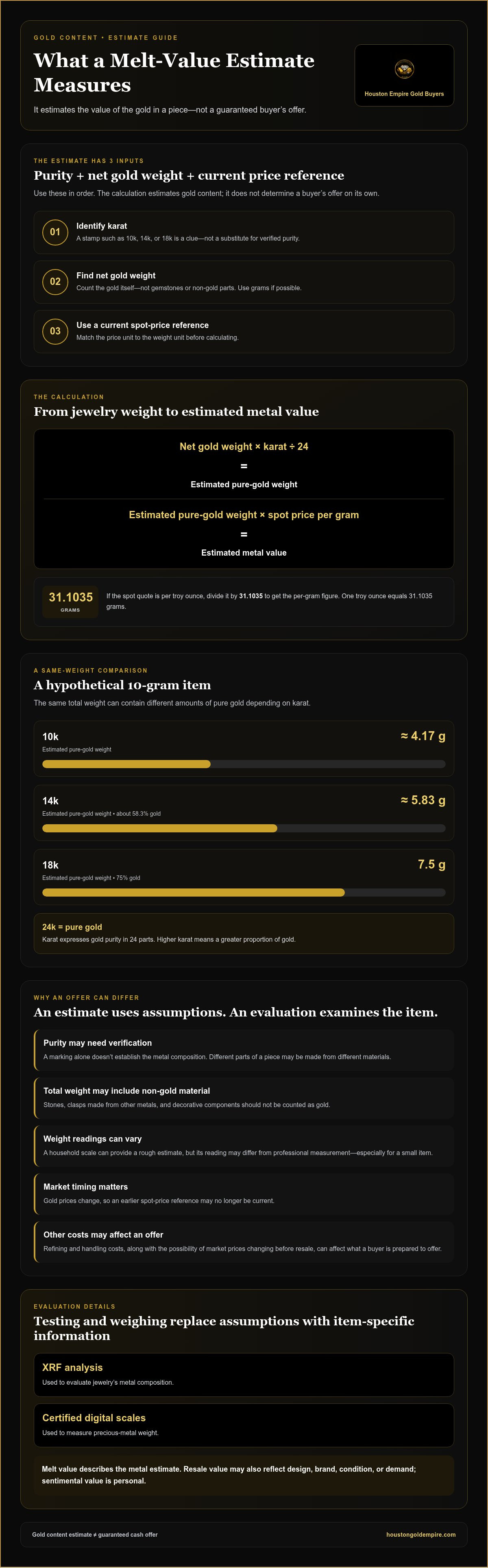
Use three inputs: the item’s karat, its net gold weight, and a current spot-price reference for gold. Work through them in order. The result estimates the gold content’s market value, not a buyer’s offer.
- Identify the karat. Check for a stamp, such as 10k, 14k, or 18k. Treat a stamp as a useful clue, not a substitute for verified purity.
- Establish net gold weight. Count the gold itself, not the full weight of gemstones or non-gold parts. Use grams if possible.
- Apply the spot-price reference. Convert the quote to the same unit as your weight before calculating.
Formula: net gold weight × karat ÷ 24 = estimated pure-gold weight. Multiply that result by the spot price per gram to estimate metal value. If the spot quote is per troy ounce, divide it by 31.1035 to get a per-gram figure, since one troy ounce equals 31.1035 grams.
How karat changes the estimated gold content
Which weight belongs in the calculation?
Stones, clasps made from other metals, and decorative non-gold components shouldn’t be counted as gold. A household scale can help you form a rough estimate, but its reading may differ from a professional measurement, especially for a small item. That difference affects the calculated gold weight and estimate.
If you’re ready to compare your estimate with an in-person evaluation, bring us your gold jewelry, including scrap or broken pieces.
Why a Jewelry Buyer’s Offer Can Differ From Melt Value
A melt-value calculation is an estimate based on the information used to make it. A buyer’s offer follows an assessment of the actual item, so the two figures can differ. The estimate answers what is the melt value of my jewelry under certain assumptions; the offer reflects what the buyer can determine about that specific piece.
A home estimate may assume the entire item has one purity or that its full weight is gold. In practice, a piece may include components made from different materials, and a marking alone doesn’t establish the metal composition. Refining and handling costs, as well as the possibility of market prices changing before the metal is resold, can also affect what a buyer is prepared to offer. There isn’t one fixed payout formula that applies to every item.
What testing and accurate weighing contribute
Testing and careful weighing help replace assumptions with item-specific information. Establishing the metal composition and precious-metal weight gives you a more informed estimate. We use XRF analysis and certified digital scales to evaluate jewelry and explain the details that contribute to an offer. For background on one way gold composition may be assessed, see how XRF gold testing works.
Why live market pricing matters
Gold market prices change, so a calculation made earlier may no longer use a current reference. That timing difference can shift the theoretical estimate, even if the jewelry itself hasn’t changed. A spot-price reference helps explain the metal’s market context, but it doesn’t determine an offer on its own. Learn more about how gold market trends affect a payout.
Getting a Transparent Melt-Value Evaluation in Houston
A rough estimate can help you decide whether you want to explore selling, but it doesn’t have to settle the question. Bring in the gold jewelry you’re considering, including scrap or broken pieces. A damaged clasp or separated chain doesn’t prevent us from evaluating its gold content.
We’ll examine the items and explain the details that inform an offer before you decide how to proceed. You can bring several pieces together, even if you’re unsure of their karat or whether every item is gold. We serve Houston and nearby communities, including Katy, Bellaire, Cypress, Sugar Land, and Pearland. For broader preparation guidance, our article on how to sell gold jewelry in Houston offers more context.
What to bring and what to expect
Gather the pieces you’d like considered, including broken jewelry and items you no longer wear. If you know a piece’s karat marking, bring that context along, but don’t rely on it as the final assessment. We’ll review the jewelry’s gold content and weight, then explain the offer clearly so you can make your own decision.
Take the next step with a Houston gold buyer
Our team is here to help you understand the evaluation. If you’d like to talk before bringing your jewelry in, call or text us. You can also visit when it suits you. We’ll answer your questions and help you consider your next step with confidence.
Bring your jewelry when you’re ready, and we’ll take it from there.
Turn Your Estimate Into a Confident Next Step
The question “what is the melt value of my jewelry” can help you start thinking about your options, but your next move is personal. You don’t have to decide based on a rough calculation alone. Use an in-person evaluation to understand the details behind an offer, then take the time you need to consider what feels right for you.
Selling jewelry can carry more meaning than a number on a scale. Some pieces are simply ready to move on; others may hold memories or matter for reasons beyond their gold content. Knowing where you stand can help you make a considered choice, whether you decide to sell now or keep the item.
We’re here to make the process clear and straightforward. Visit us at 1427 Gessner Rd in Houston for an in-person evaluation and immediate payment for your precious metals and jewelry.
Frequently Asked Questions
How do I calculate the melt value of my gold jewelry?
To work out what is the melt value of my jewelry, estimate its pure-gold weight, then apply a current gold spot price in matching units. Multiply net gold weight by karat and divide by 24; multiply that result by the per-gram price if your weight is in grams. If the quote is per troy ounce, convert it to a per-gram price by dividing by 31.1035.
Is melt value the same as the amount a gold buyer will pay?
No. Melt value estimates the gold content using the figures available to you, while a buyer’s offer follows an evaluation of the actual piece. For example, if a stamp suggests one purity but testing identifies another, the estimate may change. Net gold weight and current market pricing also matter. Treat your calculation as a useful point of comparison, not a promised payout.
Does the karat of my jewelry change its melt value?
Yes. Karat indicates the proportion of gold in the metal, so two pieces with the same total weight can contain different amounts of gold. For example, a 14k bracelet and an equally heavy 18k bracelet won’t have the same estimated pure-gold weight. A hallmark can help you make an initial estimate, but a professional assessment can establish the piece’s verified purity.
Do stones count toward the melt value of jewelry?
No. A gold-only melt calculation counts gold, not the weight of diamonds, gemstones, or other non-gold components. A ring with a large stone may weigh more on a household scale than its gold content alone would suggest. The stone or finished piece may have qualities beyond its gold content, but those aren’t represented in a gold melt-value calculation.
Can I estimate my jewelry’s melt value at home?
Yes, you can make a rough estimate at home using a karat marking, an approximate net gold weight, and a current spot-price reference. Keep pieces with different karat markings separate rather than treating a group as one uniform purity. For Houston sellers, this estimate can help set expectations before an in-person evaluation, but it may differ from an assessment based on the jewelry itself.


