

The gentler test can give a fuller answer. Comparing an XRF analyzer with an acid scratch test for jewelry damage, XRF stands out because it analyzes metal without scratching the item and can report gold content and other alloy metals. Acid testing typically gives an approximate pass-or-fail karat result, with subjective accuracy around ±1-2 karats, and the rubbing process can leave a scuff or discoloration. XRF has a limit too: a surface reading on plated jewelry can overstate the gold content beneath the outer layer.
It makes sense to want a reliable result without risking damage, especially when a piece has sentimental or resale value. The right method depends on the jewelry’s construction and the level of detail you need, not simply which test sounds more advanced. This guide compares XRF, acid testing, and deeper analysis, explains what each can reveal about plating and alloy composition, and shows how to weigh the test against the item’s value.
Key Takeaways
- Choose a testing method with the jewelry’s finish and value in mind; a non-destructive scan can help avoid a scratch or scuff.
- For plated or mixed-construction pieces, surface readings need careful interpretation because the outer layer may not reflect the metal beneath.
- Use alloy analysis to learn more than karat alone: it can identify gold content alongside other metals in the piece.
- Match the test to your decision: a quick screening may suit a straightforward item, while valuable or complex jewelry can call for more detailed analysis.
How accurate is XRF gold testing compared to acid testing?
When comparing an XRF analyzer with an acid scratch test for jewelry damage, weigh detailed analysis against surface preservation. XRF analyzes the tested area without physically altering the item; acid testing checks a streak against a karat solution.
Non-Destructive XRF Testing
An XRF device directs X-rays at the jewelry and measures the metal’s response. The method leaves the item physically untouched, unlike rubbing it against a testing stone. An analyzer with an SDD detector can reach 0.01% precision. It reports gold content and alloy metals, but a surface reading can overstate the gold in plated or gold-filled jewelry.
Acid Scratch Testing and Surface Damage
Acid testing involves rubbing jewelry against a testing stone, then applying a chemical such as hydrochloric acid to the streak. The acid goes on the stone, not directly on the item, but rubbing can still scuff it. The test may also discolor the tested area or dull polished silver. On a finished or collectible piece, visible changes can affect its condition and potential value.
Acid Testing for Approximate Karat Screening
Acid testing compares a streak with solutions marked for specific karats, such as 14K or 18K. A 14-karat solution dissolves a 10-karat streak but leaves a 14-karat streak untouched. The pass-or-fail result is subjective, with approximate accuracy of ±1-2 karats. It doesn’t identify all alloy elements, such as silver or copper, in the sample.
| Method | Damage | Result | Useful for |
|---|---|---|---|
| XRF | Non-destructive | Gold percentage and alloy metals | Composition detail |
| Acid test | May scuff or discolor | Approximate karat screen | Basic comparison |
In the United States, jewelry XRF testing charges depend on the provider and evaluation scope; the price is given after a quote request. Acid scratch test charges also vary by item and service, with the price provided after a quote request.
Choose XRF when preserving the surface and learning alloy details matter; use acid screening for a basic karat comparison when a mark is acceptable. If that evaluation leads you to consider a sale, these gold jewelry selling options can help you think through the next step.
XRF detection of plated jewelry and underlying metals
A handheld XRF analyzer can identify gold content, alloy metals, and possible plating without cutting the jewelry. However, it reads the tested surface, so one scan may not represent every part of a plated or mixed-construction piece.
XRF Detection of Plating and Karat
XRF measures metal composition at the scanned spot and can report karat alongside other elements. A thin gold layer may produce a surface reading that overstates the gold content of the core. On jewelry with wear, solder joints, or mixed construction, scanning and comparing several spots can reveal variation. This provides more information than a single surface check.
Acid Tests for Detecting Plating
Acid testing compares a streak against a karat solution, but it may not reveal what lies beneath gold plating. Reaching the underlying metal may require a deeper scratch that leaves a visible mark. Thick gold plating over brass can mislead a basic scratch test, and acid testing may not identify every metal in the item. It is less reliable than XRF for assessing plating.
XRF Limits on Alloys and Plated Items
XRF reports the elements detected at the test location, not necessarily the full composition of a layered piece. Gold plating can conceal a different core, while solder or uneven construction can cause readings to vary across one item. Results are most informative when several relevant spots are scanned and compared, rather than treating one surface reading as a complete analysis.
For example, XRF can identify gold, silver, and copper in an alloy, while an acid result cannot name all the alloy’s elements. XRF can also flag metals that need closer interpretation, but an elemental reading alone does not establish whether a metal is hazardous or creates an exposure risk. Do not treat a test result as a safety conclusion or investment-grade assessment.
How XRF analyzes jewelry alloy composition
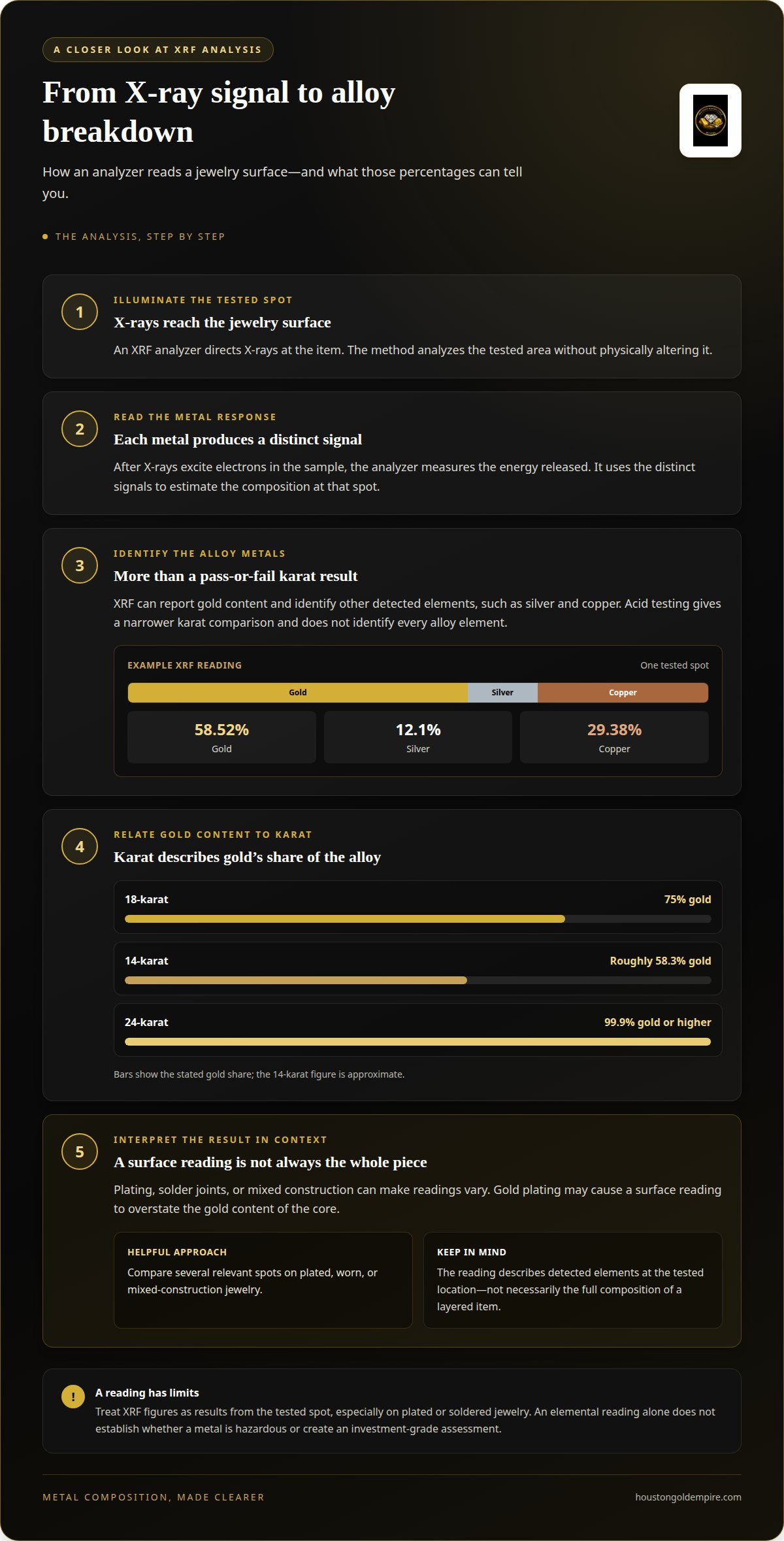
An XRF analyzer identifies metals by measuring energy released from excited electrons after X-rays reach the sample. Each metal produces a distinct signal, which the device uses to estimate the composition of the tested surface. Rather than only indicating whether a streak matches a karat solution, XRF can report gold content as a percentage and identify alloy metals such as silver and copper.
That composition helps explain why two pieces with the same karat can differ in color or metal mix. For example, an XRF reading might show 58.52% gold, 12.1% silver, and 29.38% copper. The percentage is more specific than a broad karat category, while the alloy breakdown shows which other metals contribute to the sample.
Karat expresses gold purity as a share of the alloy. 18-karat gold contains 75% gold, while 14-karat gold is roughly 58.3%; 24-karat gold is 99.9% or higher. XRF can report purity in karats, including 18K, 22K, and 24K, alongside the measured elemental composition. This helps distinguish gold content from the other metals in an alloy.
Acid testing answers a narrower question. A tester applies an acid solution to a streak and observes whether it remains or dissolves, but the reaction does not identify every alloy element. Gold testing may use hydrochloric acid; nitric acid is another strong corrosive chemical that requires careful handling. Neither acid test provides the element-by-element percentage breakdown available from XRF.
Treat XRF figures as readings from the tested spot, especially on jewelry with plating or solder. A surface result may not represent the core, and composition can differ between spots. XRF provides useful detail without removing a sample; acid screening provides a simpler reaction, not a complete alloy analysis.
Choosing a test based on the item's value
Choose a testing method based on the item’s condition, construction, and importance. For a polished heirloom, preserving the finish may matter as much as identifying the metal. Choosing between an XRF analyzer and an acid scratch test to avoid jewelry damage means weighing that trade-off. Decide what you need the result to tell you before selecting a test.
A basic karat screen may be enough to sort a straightforward piece. If you need alloy details, XRF can report gold content alongside other metals. Plated or soldered jewelry needs careful assessment because one reading may not reflect every part. Comparing readings from a clasp, chain, or repaired section can show differences.
Fire assay is another option when a sample’s overall purity matters more than preserving it. Because it consumes the sample, it is a poor fit for wearable or sentimental jewelry when keeping the item intact is a priority. Results can take hours or even days, making fire assay different from a surface screening method.
| Method | What it tells you | Damage trade-off | Useful fit |
|---|---|---|---|
| XRF | Surface composition and elements | Non-destructive | Valuable, intact, or mixed pieces |
| Acid testing | Approximate karat screen | May mark the surface | Basic screening when a mark is acceptable |
| Fire assay | Sample purity | Consumes the sample | Analysis where preservation is secondary |
Consider the consequences of an imperfect result. A simple screening may help with basic sorting, while unclear plating or mixed construction calls for more detail. A comparison of an XRF analyzer versus an acid scratch test for jewelry damage should account for the piece’s condition as well as the information you need. For valuable or sentimental jewelry, prioritize preservation; destructive analysis makes sense only when whole-sample results matter more.
Explore options for selling gold jewelry
Houston Empire Gold Buyers: Gold Jewelry (10k - 24k)
Houston Empire Gold Buyers is Houston’s trusted number one local gold buyer. We evaluate gold jewelry from 10k through 24k, as well as gold coins and bullion, silver jewelry and bullion, and estate jewelry pieces. We use XRF analysis and certified digital scales, and test items in front of you so you can see the evaluation process.
We explain our evaluation transparently, use live market pricing, and pay cash for accepted items with no hidden fees. You decide whether to proceed. Contact Houston Empire Gold Buyers when you’re ready to discuss an in-person evaluation.
Make Your Next Jewelry Decision With Confidence
Before testing, decide what you need the result to help you do. Are you considering a sale, sorting inherited pieces, or trying to understand an item’s metal composition? Your purpose can guide the choice between detail and surface preservation. Choosing an XRF analyzer versus an acid scratch test for jewelry damage starts with the consequences of altering the piece, not just the speed of the test.
If you may sell your jewelry, bring it in its current condition and explain any concerns about its finish, sentimental value, or construction. Our private, in-person evaluation gives you a clear basis for deciding what to do next. You stay in control of that decision.
Take the next step at your own pace, with a clearer understanding of what matters to you and your jewelry.
Frequently Asked Questions
Can XRF testing damage jewelry or gold items?
XRF testing does not physically alter jewelry during analysis. The instrument reads the metal in the scanned area, so a Houston seller can request an assessment without scraping a polished surface. The result still represents the tested spot, not necessarily every component. On a piece with solder, clasps, or sections made from different metals, separate readings can help clarify what each part contains.
Gold Analyzer vs Acid Test: Which Method Is More Reliable?
For detailed information about gold and alloy composition, an XRF analyzer provides more than an acid comparison. Acid testing can screen a streak against a karat solution, but it does not identify every metal in the alloy. The best choice depends on your decision: a quick karat screen may be enough for basic sorting, while composition details can help assess a mixed-metal piece.
Is acid testing safe for my jewelry?
Acid testing can leave a mark, so it may not suit jewelry whose polished finish or condition you want to preserve. The acid is applied to a streak on a testing stone, but making that streak involves rubbing the item against the stone. Testing solutions are corrosive and require careful handling and storage. Consider the finish before choosing this method.
Can XRF detect gold plating better than acid?
XRF can detect a surface reading that suggests plating, but one scan may not accurately reveal the underlying core. Acid testing may also miss plating unless a deeper scratch reaches below the outer layer, risking a mark on the piece. On a worn chain or a ring with soldered sections, comparing readings from several spots provides more context than relying on a single test point.
Is the radiation from an XRF analyzer safe for daily use?
An XRF analyzer uses X-rays, so operators should follow the specific instrument’s radiation-safety and operating instructions every time. Do not treat it as an ordinary handheld tool or operate it without understanding its safety procedures. A jewelry test result alone does not establish the operator’s exposure or safe-use conditions. Routine analysis should be performed by trained personnel following the manufacturer’s guidance.
Does XRF work on white gold, platinum, and palladium?
Yes, XRF can analyze the metal composition of white gold and identify elements such as platinum or palladium when present in the tested area. White gold’s appearance alone does not establish its alloy, so a composition reading is more useful than judging by color. On a piece with multiple components, such as a clasp and chain made from different metals, readings at separate points can show those differences.


