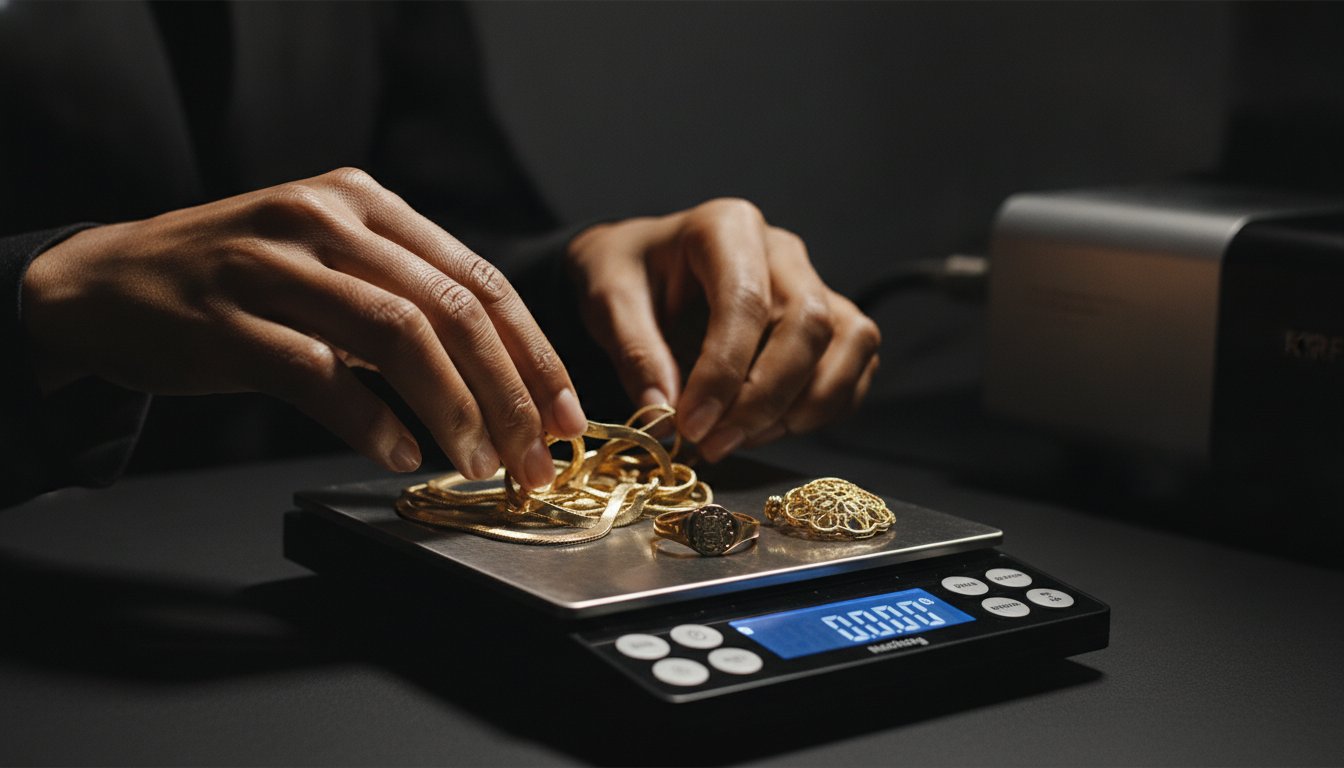
Why would you let a broken clasp or a missing earring stud stop you from collecting thousands of dollars? Many people assume that a kinked chain or a crushed ring loses its worth, but in the precious metals market, "damaged" is just a label. Your items hold value in their atoms, not their aesthetics. It's natural to feel hesitant when you want to sell damaged gold jewelry, especially if you're worried about being cheated by a mall kiosk or confused by how broken items are priced.
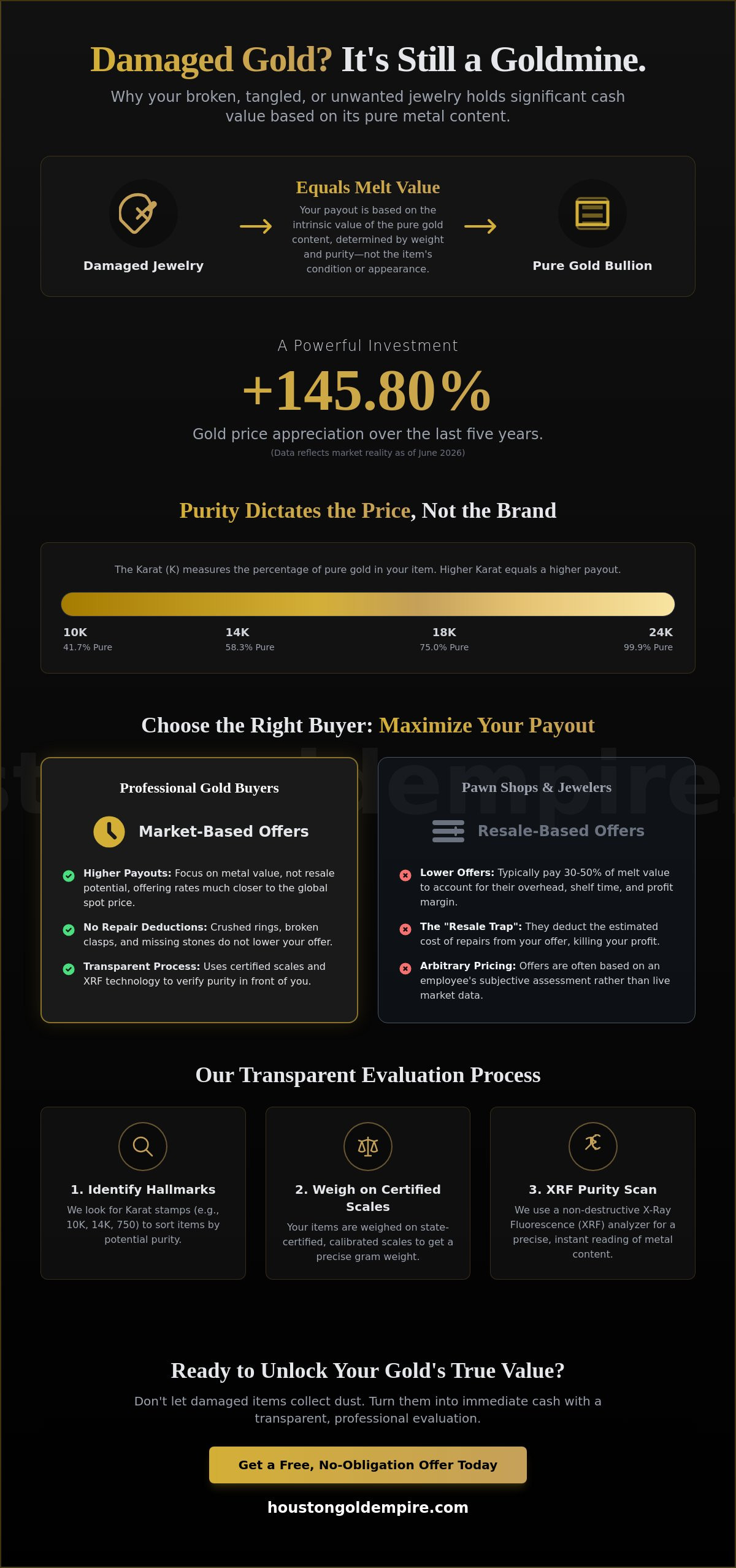
You deserve a payout that reflects the June 2026 market reality, where gold has appreciated 145.80% over the last five years. This guide will teach you why the condition of your gold doesn't affect its intrinsic value and how to secure the highest local payout through professional verification. We'll walk through the transparent evaluation process that ensures you receive fair market value and immediate cash for your assets today. You don't have to deal with the anxiety of mail-in services or the mystery of hidden fees. Instead, learn how to watch the evaluation happen in person so you can walk away with the money you've earned.
Key Takeaways
- Condition is irrelevant because value is based on pure gold content. Learn how "melt value" secures your payout regardless of damage.
- Discover why specialized metal buyers offer higher rates than pawn shops when you sell damaged gold jewelry by eliminating repair deductions.
- Master the "Magnet Test" and hallmark identification to verify your items at home before visiting a professional buyer.
- Understand how XRF testing provides a non-destructive, precise analysis of your assets to guarantee an accurate offer.
- Secure an immediate cash payment locally and eliminate the anxiety of shipping items through the mail.
The Intrinsic Value of Damaged Gold Jewelry: Why Condition Doesn’t Matter
Don't let a broken clasp or a snapped chain fool you. When you sell damaged gold jewelry, you aren't selling a fashion accessory. You're selling a globally traded commodity. Professional buyers define "damaged gold" as any item that is no longer wearable or marketable as jewelry in its current state. This includes items with missing stones, deep scratches, or structural failures. We don't see the damage. We see the raw materials. Your payout is based on the metal itself, not the condition of the piece.
The industry operates on a concept called "melt value." This is the intrinsic value based strictly on the gold content of your item. A professional buyer views your jewelry as a collection of gold atoms rather than a finished product. Whether a necklace is a tangled mess or a pristine heirloom, the weight and purity of the gold remain the same. The market doesn't care about the craftsmanship of a broken piece. It only cares about the weight of the precious metal it contains. This is why you can still secure a significant payout for items you might otherwise consider trash.
Common types of damaged gold include:
- Tangled or knotted chains that cannot be unraveled safely.
- Single earrings that have lost their match over time.
- Broken clasps, snapped bracelets, and crushed ring bands.
- Items with missing gemstones or damaged settings.
Understanding Karat Weight and Purity (10k - 24k)
Purity is the engine of your payout. You need to understand how gold purity is measured to estimate your return accurately. For example, 10k gold contains 41.7% pure gold, while 24k gold is 99.9% pure. The "karat" is the only metric that matters for damaged pieces. Brand names and styles disappear during the evaluation. Only the purity dictates the final offer price. If you have a broken 18k chain, it contains more pure gold per gram than a pristine 10k ring.
Why "Scrap Gold" is a Misleading Term
The word "scrap" often makes sellers feel like their items are worth less than "real" jewelry. This is a mistake. In the precious metals industry, "scrap" simply means the item will be refined back into its pure form. The value of this gold follows the global spot price in real-time. In June 2026, the spot price reached approximately $4,358.81 per troy ounce. Your broken jewelry is tied to this massive global valuation regardless of its shape. Scrap gold is high-purity metal awaiting its next form.
Why Professional Gold Buyers Pay More for Damaged Pieces Than Pawn Shops
Choosing where to sell your assets is just as important as the items themselves. Most people instinctively head to a pawn shop, but this is often a costly mistake. Pawn shops are "resale buyers." Their business model depends on buying items they can clean and put back in a display case for a quick retail profit. If you want to sell damaged gold jewelry, a pawn shop sees a liability. They see an item that requires labor, parts, and specialized cleaning before it can generate revenue. In contrast, professional gold buyers are "metal buyers." We focus on the refining value of the gold itself.
Because professional buyers move high volumes of precious metals, they can offer much tighter spreads to the spot price. A pawn shop might pay 30% to 50% of the gold's value because they have to account for the risk of the item sitting on a shelf for months. A dedicated gold office operates with efficiency and speed. We don't care if a ring is crushed or a chain is snapped. We evaluate the purity, weigh the metal on certified digital scales, and offer a price based on the current global market. This specialization allows for a higher payout and a transaction that takes minutes rather than an afternoon of haggling.
The Resale Trap: Why Repairs Kill Your Profit
Jewelry stores and pawn shops must account for the cost of making an item "salable." If a clasp is broken or a stone is missing, they deduct the estimated repair costs from your offer. This is the resale trap. You lose money because of a mechanical flaw that doesn't actually reduce the amount of gold present. Selling your items as scrap removes these arbitrary deductions. You receive a payout based on the raw material, which often yields a higher net profit for damaged pieces. Don't let sentimental value or "retail potential" cloud the math. Focus on the metal.
Market-Based Offers vs. Arbitrary Pricing
Professional buyers use live market tickers to ensure your offer is accurate to the second. In June 2026, the spot price of gold reached approximately $4,358.81 per troy ounce. We use this data alongside state-regulated, certified digital scales to provide a transparent valuation. This eliminates the "arbitrary pricing" common in generalist shops. You can see the weight and the current market rate for yourself. You can learn more about how these variables impact your specific items by checking out our guide on how much is my gold jewelry worth.
4 Steps to Evaluate Your Broken Jewelry Before Visiting a Buyer
Preparation is the key to a confident transaction. You shouldn't walk into a buyer's office without a basic understanding of what you hold. While a professional evaluation is necessary for a final offer, doing your own homework prevents surprises. It also helps you identify which items are likely solid gold and which might be plated. Follow these steps to organize your items before you sell damaged gold jewelry in Houston.
Reading the Fine Print: Common Gold Hallmarks
Grab a magnifying glass or use the macro setting on your smartphone camera. Look for tiny stamps called hallmarks. These numbers tell you the purity of the metal. Common stamps include:
- 417: This indicates 10k gold (41.7% pure).
- 585: This indicates 14k gold (58.5% pure).
- 750: This indicates 18k gold (75.0% pure).
Clasps are often where these stamps live. If a chain is snapped and the clasp is missing entirely, don't worry. We can still verify the metal using advanced technology. However, be wary of stamps like "GF" (Gold Filled), "GP" (Gold Plated), or "HGE" (Heavy Gold Electroplate). These items contain very little gold and usually don't have significant melt value because they aren't solid gold.
The Magnet and Visual Inspection
Use a strong magnet from your toolbox. Precious metals like gold, silver, and platinum are not magnetic. If your "gold" ring jumps to the magnet, it's likely a base metal like steel or nickel with a thin gold coating. You should also look for "brassing." This occurs when the gold plating wears thin on broken edges or high-friction areas, revealing a different colored metal underneath. Even if your item fails these home tests, a professional XRF scan is the final word on its chemical composition.
Once you've inspected your items, group them by their karat stamps. This organization allows for a much faster and more transparent evaluation at our office. Finally, check the current market rates. As of June 16, 2026, the spot price of gold is approximately $4,358.81 per troy ounce. Knowing this number helps you manage your payout expectations and ensures you're getting a fair offer based on real-time data. Transparency starts with your own inspection.
How XRF Testing Guarantees an Accurate Offer for Your Gold
Guesswork has no place in a financial transaction. When you sell damaged gold jewelry, you need more than a visual estimate or a subjective color test. You need scientific precision. X-Ray Fluorescence (XRF) is a non-destructive elemental analysis that identifies the exact chemical signature of your metal. It allows us to see through the surface and determine the precise percentage of gold, silver, copper, and other alloys within your items. This technology ensures that you receive every cent of value your jewelry holds, regardless of its condition or lack of hallmarks.
Accuracy in testing leads directly to higher payouts. If a buyer uses outdated methods, they often "lowball" the offer to protect their own profit margins against uncertainty. XRF eliminates that uncertainty. By knowing the exact purity of the melt, a professional buyer can offer a price that is much closer to the global spot market. You can see the results for yourself on a digital screen, providing a level of transparency that traditional shops simply cannot match. Experience this precision firsthand with our Transparent Gold Testing: XRF Analysis in Houston.
Acid Testing vs. XRF Spectrometry
Many local shops still rely on the "scratch and acid" method. This involves rubbing your jewelry against a stone to leave a metal sample and then applying nitric acid to see if it changes color. It's primitive, destructive, and prone to human error. Acid testing is a game of "close enough." In contrast, XRF spectrometry provides digital precision in seconds. It doesn't damage your piece, and it removes the guesswork of interpreting acid colors. This protects you from under-valuation and ensures an honest assessment of your assets.
The Importance of Certified Scales
The weight of your gold is the second half of the payout equation. Houston Empire Gold Buyers uses state-certified digital scales that are regularly calibrated for accuracy. You should understand the units of measurement used during your evaluation. Most professional buyers use Grams (g) or Pennyweights (DWT). For reference, one troy ounce equals 31.1 grams or 20 pennyweights. Always ensure your buyer weighs your items in your direct line of sight. If you're ready for a clinical, no-nonsense evaluation, visit our Houston office for a free assessment today.
Selling Locally in Houston: Immediate Cash vs. Mail-In Services
Timing is everything in the precious metals market. When you decide to sell damaged gold jewelry, you shouldn't have to wait for a shipping kit to arrive or for a check to clear in the mail. Mail-in services often create a "waiting period" that lasts for days or even weeks. Local selling eliminates this delay entirely. You walk into a professional office with your assets and walk out with a payment in hand. This immediate liquidity is vital when gold prices are volatile. You lock in the current market rate and receive your funds on the spot.
Security is the other major advantage of staying local. Shipping your valuables through the mail introduces unnecessary risks. Even with insurance, the anxiety of a lost package or a disputed claim can be overwhelming. A face-to-face consultation allows you to maintain possession of your items until the moment of sale. You watch the evaluation, ask questions about the XRF results, and participate in the process. This transparent interaction builds a level of trust that a remote service simply cannot provide. You aren't just a tracking number. You're a neighbor receiving a professional financial service.
Why In-Person Beats the "Gold Kit"
Many national companies promote "free" shipping kits as the ultimate convenience. There is a hidden cost to these kits. The expense of overnight shipping, insurance, and marketing is often baked into their offer prices. This results in lower payout rates for the seller. In-person buyers operate with lower overhead per transaction, allowing them to pass more value to you. Additionally, you retain total control. If you don't like the offer, you take your items home instantly. There's no waiting for a return shipment or worrying about your jewelry being held hostage by a remote processing center.
Convenient Houston Locations
Houston Empire Gold Buyers provides a safe, professional office environment for high-value transactions. We proudly serve the entire Greater Houston area, including Katy, Sugar Land, and Spring Branch. Our commitment to the local community ensures that you receive an honest, clinical assessment of your assets without the pressure of a retail environment. We understand the Houston market and the specific needs of our local clients. Don't settle for the uncertainty of a mail-in kit. Visit Houston Empire Gold Buyers for a free evaluation today! and secure the payout you deserve based on the latest June 2026 market data.
Secure Your Highest Payout Today
Your broken jewelry is a financial asset. A snapped chain or a crushed ring still contains the same high-purity metal as the day it was forged. You now understand that condition is irrelevant to market value. By bypassing pawn shop deductions and mail-in delays, you position yourself for a superior return. Precision is the foundation of a fair deal. When you choose to sell damaged gold jewelry, you deserve an evaluation that leaves no room for guesswork.
Houston Empire Gold Buyers combines advanced XRF Spectrometry for 100% accuracy with state-certified digital scales. We eliminate the uncertainty of traditional testing methods to ensure you receive every cent of your item's worth. Our process is transparent, efficient, and designed for your security. You can watch the entire verification and walk out with immediate on-the-spot payments. Don't let your assets sit in a drawer losing potential. Take the next step toward a professional transaction.
Get a Free XRF Evaluation for Your Damaged Gold in Houston and turn your broken pieces into immediate cash today. We are ready to provide the clinical, honest assessment you expect from a local expert.
Frequently Asked Questions
Does broken gold jewelry lose value because it cannot be worn?
No, broken jewelry does not lose value because its worth is tied to the raw gold content, not its wearability. When you sell damaged gold jewelry, we calculate the payout based on the weight and purity of the metal. A snapped chain contains the same number of gold atoms as a pristine one. We focus on the "melt value," which follows global market rates regardless of the item's physical condition.
Can I sell gold jewelry that is missing gemstones or diamonds?
Yes, you can sell items with missing stones. We specialize in buying the precious metal itself. If your ring has lost its center diamond or a bracelet is missing several small gems, it does not prevent you from receiving a competitive offer for the remaining gold. We evaluate the weight of the metal separately from any stones to ensure you get a fair price for the gold content.
How do I know if my damaged jewelry is real gold or just plated?
You can look for hallmarks like 10k, 14k, or 585 on the clasp or inner band. A strong magnet can also help; if the item sticks, it is likely a base metal with thin plating. However, surface tests are often inconclusive for damaged pieces. Our professional XRF spectrometry provides a definitive analysis by scanning the elemental composition of the item without damaging it further.
What is the difference between scrap gold and estate jewelry?
Scrap gold refers to items destined for the refinery to be melted down and repurposed. This includes broken chains and single earrings. Estate jewelry consists of intact, high-quality pieces that have resale value as finished jewelry. While estate pieces might fetch a premium for craftsmanship, damaged items are priced strictly by their weight and purity according to the real-time spot price of gold.
Should I try to repair my broken jewelry before selling it?
You should not repair your jewelry before selling it to a professional metal buyer. The cost of labor and materials for repairs often exceeds the marginal increase in resale value. Since we evaluate your items based on their intrinsic gold content, a repaired clasp won't increase your payout. Save your money and sell the items in their current state to maximize your net profit from the transaction.
How long does a professional gold evaluation take in Houston?
A standard evaluation typically takes between 10 and 15 minutes depending on the number of items you bring. Our process is designed for efficiency and transparency. We sort your items by karat, weigh them on certified scales, and use XRF technology for instant purity verification. You can watch the entire process and receive an offer immediately, allowing you to complete the transaction quickly during your day.
Do I need an appointment to sell my damaged gold at Houston Empire Gold Buyers?
No appointment is necessary to visit our Houston office. We welcome walk-in clients during our standard business hours for immediate evaluations at Houston Empire Gold Buyers. This flexibility allows you to sell damaged gold jewelry whenever it is convenient for you. Our staff is prepared to provide a clinical, no-nonsense assessment of your assets on the spot, ensuring a fast and professional experience without the need for prior scheduling.
What documents do I need to bring to sell gold for cash in Texas?
You must bring a valid, government-issued photo ID to complete a transaction. This is a requirement under Texas state law and Houston municipal regulations for all precious metal dealers. Acceptable documents include a Texas driver’s license, a state ID card, or a US passport. We record this information to comply with local law enforcement reporting requirements, ensuring a secure and legal transfer of assets for every customer.


