

Craftsmanship and buyer preferences shape how we assess estate jewelry or high-end estate pieces for resale. We consider fine materials, distinctive design, maker details, condition, and current buyer appeal. A luxury label alone doesn’t tell the whole story.
Selling inherited or pre-owned pieces can feel complicated, especially when their history and workmanship matter as much as their precious-metal content. We explain what buyers may consider so you can understand an evaluation and decide what to do next.
This guide explains how craftsmanship, condition, materials, provenance, and buyer demand can influence a sale in Houston. It also covers how precious-metal testing fits into an evaluation and when a local buyer may be a practical next step.
Key Takeaways
- Separate an item's precious-metal content from the value of its craftsmanship, design, maker, and appeal to buyers.
- Assess condition, materials, and distinguishing details to understand what may influence interest in an estate piece.
- Use appropriate expertise and tools to evaluate gemstones and identify details that support an item's authenticity.
- Learn how transparent, in-person precious-metal testing can help you understand an evaluation before deciding what to sell.
How much do high-end estate pieces typically cost?
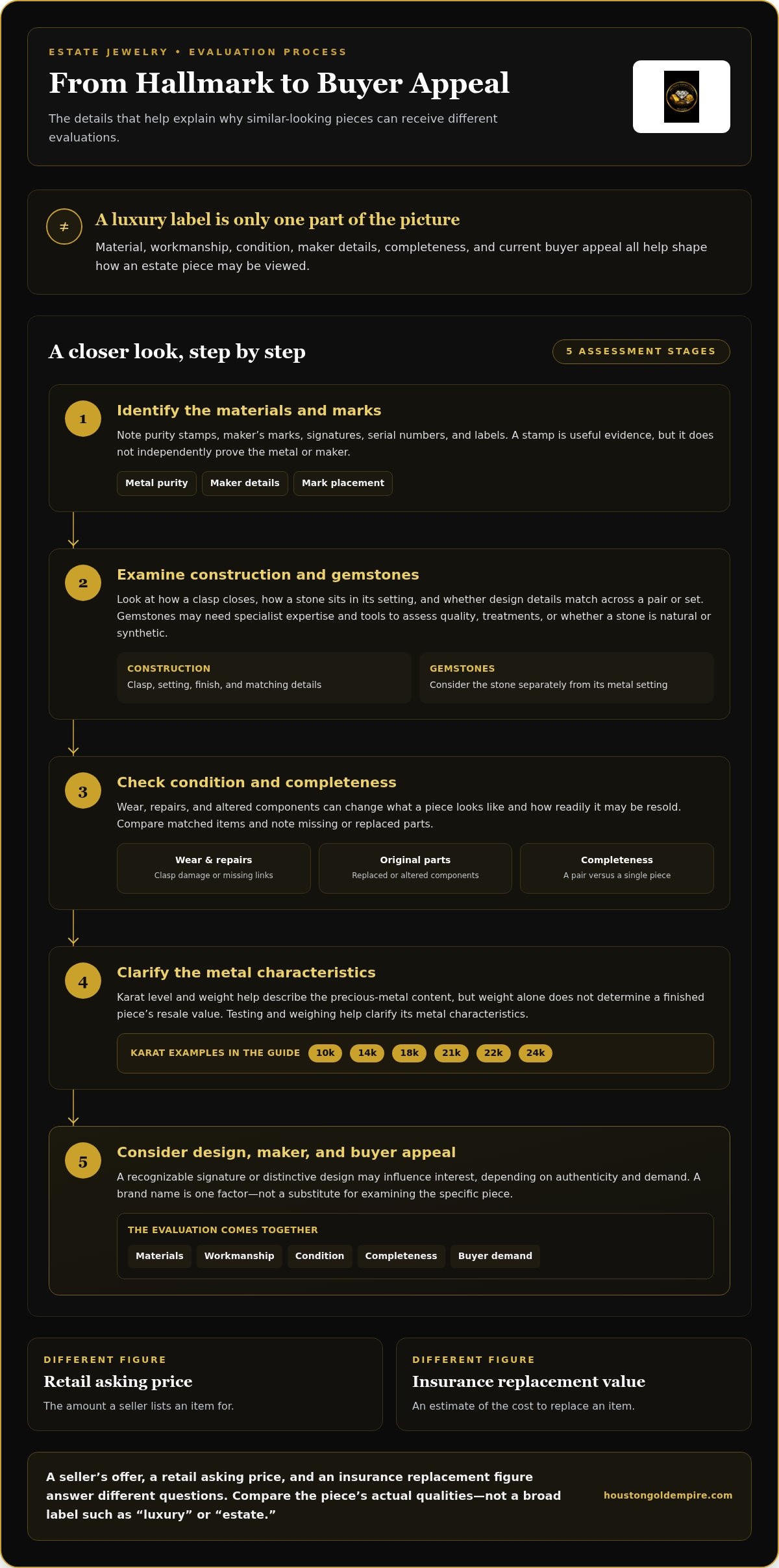
There isn’t one typical price for estate jewelry or high-end estate pieces. A vintage gold ring, a signed necklace, and a matched set of earrings differ in materials, workmanship, and buyer appeal. A seller’s offer also differs from an item’s original retail price or insured replacement value. Each figure answers a different question, so comparing them directly can create unrealistic expectations.
Start with the item’s material. Gold purity affects how much fine gold a piece contains: 10k, 14k, 18k, 21k, 22k, and 24k indicate different karat levels. Weight matters, but weight alone doesn’t determine a finished piece’s resale value. A buyer also considers construction, condition, and whether design or maker details add appeal beyond its metal content.
Brand and design may influence interest, but a famous name doesn’t automatically determine a price. A Cartier bracelet, Tiffany & Co. pendant, and unsigned gold chain differ in recognition, style, condition, and demand. Buyers may look for identifiable marks and original design features. A brand name is one factor in an evaluation, not a substitute for examining the specific piece.
- Metal content: A plain 14k band and an ornate 18k ring differ in purity, weight, and workmanship. Testing and weighing help clarify their metal characteristics.
- Gemstones: A diamond ring’s stone, setting, and condition affect its appeal. The metal setting and the gemstone are distinct parts of the item.
- Maker and design: A signed Tiffany & Co. piece may attract different interest from an unsigned item. The signature needs to correspond with the actual object.
- Condition: A wearable bracelet may present differently from one with a damaged clasp or missing links. Repairs can change the piece’s appearance and usefulness.
- Completeness: A matching pair of earrings differs from a single earring. Original components and matching parts can affect buyer interest.
- Market demand: A distinctive design may interest some buyers, while a familiar, wearable style may appeal to others. Preference changes by item and audience.
Distinguish potential sale proceeds from other valuations. An insurance replacement figure estimates the cost of replacing an item, while a retail asking price is the amount a seller lists it for. Neither automatically establishes what a buyer will pay for a pre-owned piece. Resale offers consider the item itself, its materials, condition, and likely demand.
For example, two gold necklaces can share the same karat mark yet differ in weight, design, maker, and wear. A recognizable signature may add appeal, depending on its authenticity and buyer interest. A damaged clasp or missing pendant may also affect how readily the necklace can be resold. The karat stamp alone doesn’t explain these differences.
When comparing an offer with an old receipt, note what each document describes: the maker, metal purity, gemstones, and distinguishing marks. A receipt may record an earlier retail transaction, while a current evaluation examines the item as it is now. Matching the descriptions helps explain differences without treating an old purchase price as a guaranteed resale amount.
For Houston sellers, the practical answer is that an item’s specific qualities matter more than a broad label such as “luxury” or “estate.” Identify the piece, distinguish its metal and gemstone components, and consider its condition and buyer appeal together. This helps explain why similar-looking pieces can receive different evaluations.
Those figures are not prices for estate jewelry. They describe homes, not rings, necklaces, or other objects, so they cannot set a jewelry seller’s expectations or establish a comparable resale amount. Property-market figures should stay in context; they are not a benchmark for an individual piece of jewelry.
For an estate piece, focus on its metal, gemstones, maker, condition, completeness, and buyer interest. A home-price comparison cannot replace examining those details or indicate what a jewelry seller might receive. Keeping the categories distinct prevents a premium property listing or high-end home price range from being mistaken for a jewelry valuation. The relevant comparison is with items that share similar characteristics, not with a home.
How can you authenticate high-end estate jewelry and antiques?
Authentication combines physical examination with supporting history. A maker’s mark, metal stamp, gemstone, or family story can offer clues, but one detail rarely establishes an item’s identity by itself. Consider the materials, construction, markings, and provenance together. For example, a signed ring should be checked for consistency between its signature, design, and workmanship.
Start with a careful visual inspection. Note any maker’s marks, purity stamps, serial numbers, signatures, or labels. Record where each mark appears and whether it seems consistent with the item’s construction. A stamp inside a gold band is useful evidence, but it doesn’t independently prove the metal or maker. Wear, repairs, and altered components can also complicate what a mark appears to show.
Next, examine the piece’s construction and materials. Check how a clasp closes, how a stone sits in its setting, and whether a pendant’s back matches its visible design. Compare repeated details across a pair of earrings or a matching set. Uneven finishing, mismatched components, or a replacement clasp may indicate a later alteration. These observations don’t prove an item is fake, but they can point to details that need closer examination.
Gemstones need their own assessment. The U.S. Bureau of Labor Statistics explains that gemologists use expertise and specialized tools to assess gemstone quality, detect treatments, and distinguish synthetic stones from natural ones. For a diamond ring, the stone and setting can be considered separately. A gemstone’s appearance alone may not reveal whether it is natural, synthetic, or treated.
- Check the setting: Look for loose stones, replaced prongs, or a setting that doesn’t fit the gemstone consistently.
- Record identifying details: Photograph signatures, stamps, clasps, and unusual design features before handling or cleaning.
- Compare the whole object: A maker’s mark should make sense alongside the piece’s materials, proportions, and construction.
- Keep related records: A dated receipt, family letter, or photograph may help connect an item to its history.
For antiques, provenance means the documented history of an object’s ownership or origin. A family photograph showing the same brooch can support its history, while an old receipt may identify a maker or purchase. Keep original boxes, papers, and repair records together. These materials provide context, but each document should be compared with the object it describes.
Authentication also varies by category. A pocket watch may have a maker’s name and identifying marks inside its case; an antique brooch may have a signature and distinctive construction. A painting’s signature alone doesn’t establish authorship. For artwork, supporting records and examination of its materials and execution matter. Keep the object intact while gathering evidence, since polishing, replacing parts, or removing a label can erase useful clues.
Separate authentication from condition and value. A genuine vintage necklace may have missing stones, a repaired clasp, or components added later. These details affect its current state without automatically disproving its age or maker. Likewise, a genuine designer signature doesn’t guarantee strong buyer interest. Record what is present, what has changed, and what remains uncertain about the item’s history.
For a practical assessment, gather the piece, provenance records, and clear photographs of its marks and construction. Describe repairs honestly, and don’t treat a stamp or family story as conclusive proof. A careful review weighs physical evidence against the item’s history. This gives Houston sellers a clearer basis for understanding an estate or antique piece and the evidence behind its identification.
The Internal Revenue Service says buyers can help authenticate artwork by checking for a certificate of authenticity from a recognized authority or an expert on the artist. For artwork, check whether the certificate comes from a recognized authority or an expert on the artist.
Houston Empire Gold Buyers: Gold Jewelry (10k - 24k)
At Houston Empire Gold Buyers, we’re trusted number one local gold buyers in Houston. We evaluate estate jewelry and gold jewelry from 10k through 24k, along with gold coins and bullion, and silver jewelry and bullion.
We use advanced XRF technology and certified precision scales. We test and weigh your pieces in front of you, then explain how metal purity and weight factor into our evaluation. We use real-time market pricing, with no middlemen or hidden fees. No pressure, no obligation to sell. If you accept our offer, Houston Empire Gold Buyers pays cash on the spot.
If you’re considering selling inherited jewelry, a vintage ring, or other estate pieces, bring them to Houston Empire Gold Buyers for an in-person evaluation. Walk-ins are always welcome, or contact us to discuss your items.
Make a Confident Decision About What Comes Next
Selling a meaningful piece is also a personal decision. Before moving forward, consider whether its history, everyday use, or family connection matters more to you than letting it go. For estate jewelry or high-end estate pieces, that choice can be as important as resale appeal.
If you’re leaning toward selling, gather the pieces you’re considering and note any details you want discussed. A clear conversation helps you understand the evaluation and decide whether to proceed. Take your time, ask questions, and make your choice with the information in front of you.
When you’re ready to explore an in-person evaluation, Houston Empire Gold Buyers can help you consider your options. You don’t need to decide before you understand the process. Move forward at your own pace and choose the path that feels right for you.
Your next step can be simple, informed, and entirely your own.
Frequently Asked Questions
What are high-end estate pieces?
High-end estate pieces are previously owned items valued for qualities such as fine materials, skilled workmanship, distinctive design, or maker recognition. The term can describe inherited jewelry, vintage watches, and other luxury items; it doesn’t automatically mean an item is antique. In Houston, an inherited designer ring can be an estate piece whether it’s decades old or simply pre-owned.
What factors determine the value of an estate piece?
An estate piece’s value depends on what it is, its verifiable materials and maker, its condition, and likely buyer interest. Completeness matters too: a watch with its original components or a matched jewelry set may be evaluated differently from an incomplete item. Keep related paperwork with each piece, and separate items rather than describing a whole collection as one. That helps clarify what’s being assessed.


