

Face value doesn’t always tell the full story. A coin’s precious-metal content and rarity can affect its potential worth, so pieces with the same denomination may have different market values. Look beyond denomination to the coin’s composition and identifying details.
Start with the denomination stamped on the coin. It indicates face value, but may not reflect the value of its gold or silver content or any collector interest.
This guide explains how face value, metal content, and rarity can shape a coin’s potential value. It also covers identifying details, how condition may influence collector interest, and what to expect from a transparent evaluation in Houston.
Key Takeaways
- We identify American Gold Eagle and Gold Buffalo coins by series and metal composition to understand what may influence their value.
- We look beyond age, since rarity, mint details, and condition can affect collector interest in U.S. coins.
- We distinguish face value from precious-metal value by considering a coin’s composition and gold or silver content.
- We preserve condition and assess wear and surface quality before deciding on a coin’s next step.
American Gold Eagle and Gold Buffalo series
We identify the American Gold Eagle program as beginning in 1986. American Gold Eagles are struck in 22-karat gold and issued in four sizes, including a 1 oz size. We distinguish the karat rating from total weight, since the rating describes the gold alloy rather than indicating that the full coin is pure gold. We also consider the series’ bullion and numismatic interest in light of its specific issue and condition.
We recognize the Gold Buffalo as a distinct series introduced by the U.S. Mint in 2006 as its first 99.99% fine gold coin for the public. That purity distinguishes it from the 22-karat Eagle. We assess both as American bullion series, while keeping their different gold compositions clear. We don’t assume either series automatically has greater collector value; rarity, condition, demand, and the particular issue all matter.
Begin by noting the series, date, denomination, and any mint mark. A familiar name or Liberty design alone isn’t enough to determine value. Compare each issue’s metal content with its potential numismatic interest. Bullion issues may track their precious-metal content, while collector demand can add another factor. Keep Eagle and Buffalo issues distinct when sorting a group.
- We identify the series: We distinguish an American Gold Eagle from a Gold Buffalo before estimating gold content.
- We read size and denomination: Eagles come in four sizes, including a 1 oz issue; we note the exact type.
- We compare purity: We account for the Eagle’s 22-karat gold and the Buffalo’s 99.99% fine gold.
- We consider collector interest: We record the date and mint mark, then assess condition and demand alongside bullion value.
Keep gold issues separate from silver pieces while sorting. Similar designs or matching sets don’t mean identical metal content. Preserve each coin’s surface and note its identifying details for a clearer assessment. Avoid polishing or cleaning the pieces, since an altered finish can affect how collectors view condition. These steps help organize information when comparing gold coins from either series.
Valuable and rare U.S. coins
Collectors look beyond denomination to rarity, condition, and demand. A coin’s face value may tell only part of its story.
Valuable U.S. Coins
Valuable U.S. pieces can interest collectors because of their metal, history, or an unusual variety. The 1943 Lincoln copper penny is one example to recognize, while an 1838 O Capped Bust half-dollar is another potentially valuable issue. These examples show why identification matters: a coin’s date, mint mark, composition, and design can distinguish it from a common issue.
When researching a coin, record its date, denomination, mint mark, and visible features before estimating collector interest. Compare the exact variety, not just the general design. A gold coin may draw interest for its metal content, while collectors may value a copper issue for its history or scarcity. A coin’s place in American culture adds context, but doesn’t establish rarity on its own.
To clean, store, and handle a piece safely, don’t polish or scrub it; hold it by the edges and keep it protected from contact that could mark its surface.
Rare U.S. Coins
Rarity depends on how many examples are known and how strongly collectors seek them. The 1913 Liberty Head Nickel has five known pieces, making it a clear example of extreme scarcity. The 1870-S silver dollar is also identified as a rare U.S. issue. A familiar design alone doesn’t make every example rare; the specific date, mint mark, and variety matter.
Before buying a collectible, compare its identification, condition, and grading details with the seller’s description. Risks include a misidentified variety, undisclosed surface damage, or paying for collector interest the coin doesn’t have. Careful research is central to coin collecting, so keep records of the stated features and purchase terms.
Use a magnifier to inspect the date and mint mark, while avoiding contact with the coin’s face. If it may be rare, preserve its current condition and document identifying details before seeking an evaluation. This gives a collector or specialist clearer information without risking avoidable surface damage.
Coins as currency and their face and metal values
Face value identifies a coin’s denomination, but its metal can add another source of value. In the United States, the six main circulating denominations are the penny, nickel, dime, quarter, half-dollar, and dollar. Pennies remain among those denominations and serve as currency. Their circulation doesn’t establish whether new pennies are being minted: existing examples can remain in use independently of new production.
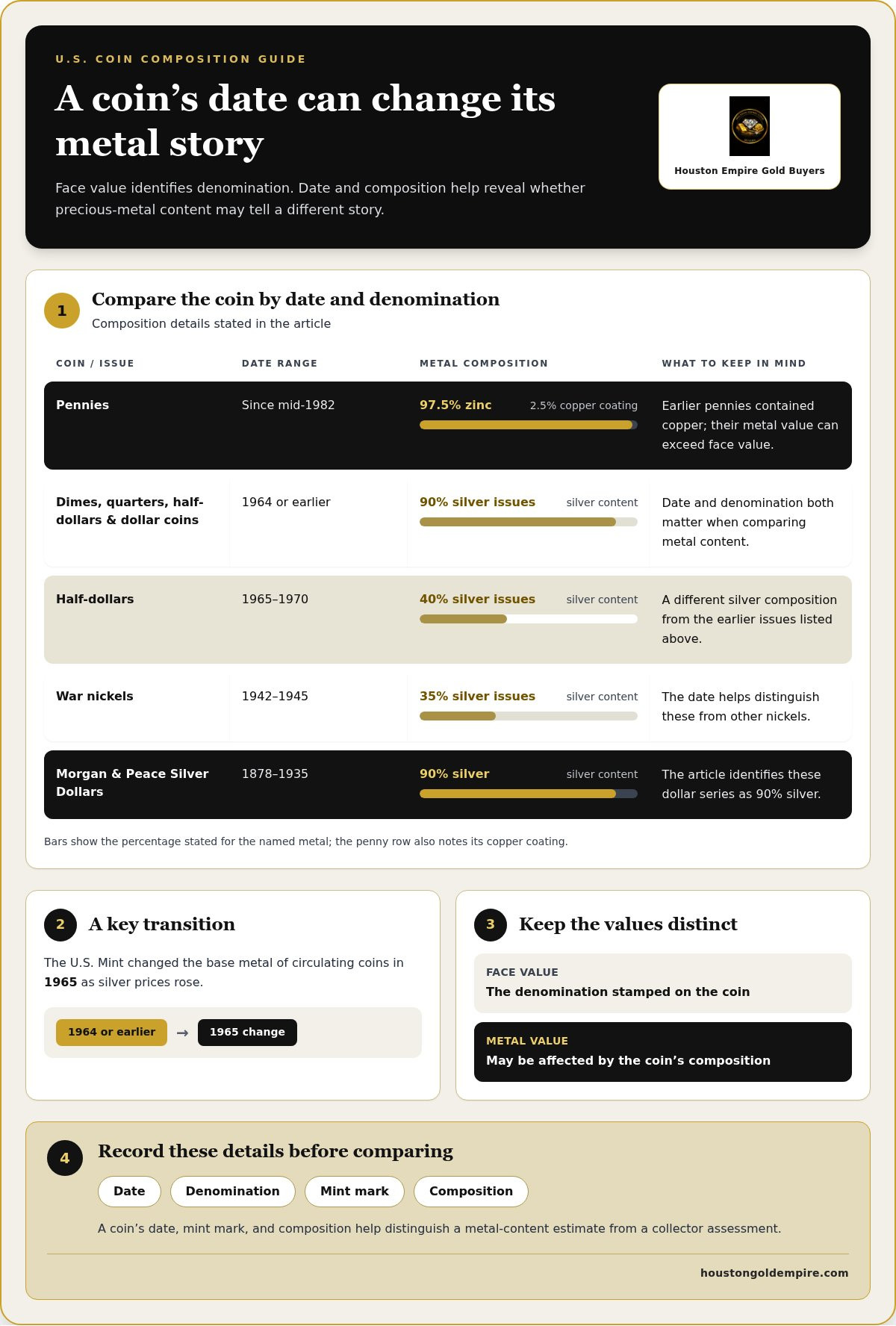
Composition can differ by date. Since mid-1982, U.S. pennies have been 97.5% zinc with a 2.5% copper coating. Earlier pennies contained copper, and their metal value can exceed their face value. That makes the date an important first detail to check, though metal content alone doesn’t determine collector interest.
Silver issues also depend on date and denomination. U.S. dimes, quarters, half-dollars, and dollar coins dated 1964 or earlier include 90% silver issues. Half-dollars dated 1965-1970 include 40% silver issues, while war nickels dated 1942-1945 include 35% silver issues. The U.S. Mint changed the base metal of circulating coins in 1965 as silver prices rose.
- Check the date: A 1964 dime and a later dime may have different metal compositions.
- Identify the denomination: A quarter and half-dollar from the same period don’t contain the same amount of silver.
- Separate metal and face value: The stamped denomination describes currency value, not necessarily the value of its metals.
- Look for a series: Morgan and Peace Silver Dollars struck between 1878 and 1935 were 90% silver.
Sort a mixed group before estimating its potential value. It may include ordinary circulation issues and coins with precious-metal content, so record each date and denomination separately. The date, mint mark, and composition help distinguish a metal-content estimate from a collector assessment. Even a small collection may include a valuable example, but face value alone won’t reveal it.
How do coin grading and condition affect value?
Condition can affect collector interest and resale value. Grading describes a coin’s preservation, including wear, surface marks, luster, and strike quality. A sharp design with original-looking surfaces may appeal more to collectors than a heavily worn example of the same issue. Grade is one factor, not a substitute for identifying the date, mint mark, and variety.
Inspect a coin under good light without touching its face. Look for wear on raised details, scratches, discoloration, rim damage, or signs of cleaning. Assess a Morgan silver dollar by its design details and surface condition, not just its age. Cleaning can leave hairlines or alter the finish, so avoid polishing it before evaluation.
- Check high points: Wear often shows first on raised design elements.
- Review the fields: Look for scratches, spots, and other marks across open surfaces.
- Examine the edges: Rim dents or damage can affect appearance and collector interest.
- Keep it protected: Handle by the edge and use a holder that prevents rubbing.
Grading labels describe condition, but a grade doesn’t tell the whole value story. Two coins from the same issue can draw different interest because their surfaces, strike quality, and eye appeal differ. Collector demand and rarity matter, too. A common date in pristine condition may be assessed differently from a scarce date with visible wear.
For a practical first review, record the date and mint mark, photograph both sides, and note visible damage. Avoid removing a coin from a protective holder if doing so could mark it. Keep any grading or purchase documentation with the coin. These steps help preserve its condition and make details easier to discuss during an evaluation.
Houston Empire Gold Buyers: Gold Jewelry (10k - 24k)
Houston Empire Gold Buyers can help when you’ve identified gold or silver coins and want to explore a sale. We purchase Gold Coins & Bullion, Silver Jewelry & Bullion, Estate Jewelry Pieces, and Gold Jewelry (10k - 24k). Our evaluation considers the item’s precious-metal content and relevant identifying details, helping distinguish bullion value from potential collector interest.
We use advanced XRF technology and certified precision scales. We test items in front of you and base our transparent evaluations on real-time market pricing. No middlemen or hidden fees. If you’re sorting a collection that includes bullion and estate pieces, bring them to us in Houston for an in-person assessment. We’ll explain the evaluation so you can make an informed decision. No pressure, no obligation to sell.
Contact Houston Empire Gold Buyers or visit our website to learn more.
Make Your Next Move With Confidence
Before selling a collection, decide which pieces you’re ready to part with and which you’d rather keep. That distinction matters when family history, collector interest, and precious-metal value overlap. Knowing your priorities helps you approach an evaluation with a clear idea of what you want.
Set aside pieces you’re considering, along with any notes or records you already have. You don’t need to settle every question alone. A transparent evaluation can help you understand the items in front of you and make a considered choice about what happens next.
Houston Empire Gold Buyers offers local evaluations for people considering a sale in Houston, Spring Branch, Katy, Cypress, and the surrounding communities. Bring your questions and the items you’re considering, including gold or silver coins. We’ll explain the evaluation process clearly, so you can decide whether to move forward.
Take the next step when you’re ready. Clear information can make it easier to decide how to move forward.
Frequently Asked Questions
How Do I Know if My Coins Are Valuable?
Start by recording each coin’s date, mint mark, denomination, and visible features. Then distinguish its potential precious-metal value from collector interest. A useful comparison needs the exact issue, not just a similar design. Keep coins in their current condition while researching: polishing can change surface details that help identify a variety or assess preservation.
What Are Collectible Coins?
Collectible coins are sought for qualities beyond everyday use as currency. Their appeal may come from a distinctive design, historical connection, limited availability, or a particular mint variety. Proof and mint sets, commemorative issues, and military gold or silver items may attract specialized interest. Collectors consider the specific issue and its condition, not age alone.
What Materials are US Coins Composed of?
U.S. coin materials vary by denomination and date. Since mid-1982, pennies have a zinc core with a copper coating; U.S. nickels contain copper and nickel. Silver issues also vary: certain dimes, quarters, half-dollars, and dollar pieces dated 1964 or earlier include 90% silver issues. Check the date and denomination before identifying a piece’s composition.
What are coins and what are they made of?
A coin is a minted piece used as currency, typically marked with a design and denomination. Its composition may be a base-metal combination, a precious metal, or a layered construction. Those materials serve different purposes: the denomination identifies its role as money, while the metal content describes what it contains. The date and type help distinguish one composition from another.
How much are common U.S. coins worth?
A common circulating coin is generally worth its stated denomination for spending. Its potential sale value may differ if it contains precious metal or has collector appeal. To assess a coin, identify its date, composition, condition, and any distinctive variety. Collectors may view a heavily circulated example differently from a well-preserved example of the same issue.
How can I identify and evaluate a rare coin?
Record the date, mint mark, denomination, and design details, then compare them with references for the exact issue. Note unusual features without cleaning or altering the coin. An evaluation considers whether the variety is genuinely scarce, its condition, and collector demand. Keep any existing holder or documentation with the coin, since those details can support identification.


