

Why does the cash offer for your gold jewelry rarely match the glowing market ticker you checked on your phone? It's frustrating to watch gold reach historic highs, only to receive an offer that feels surprisingly low. That gap leaves many sellers wondering if they are getting a fair deal. Truly understanding gold spot price vs payout is the single most important step you can take before parting with your valuables.
You deserve to know exactly how paper market rates translate into physical cash in your hand. In this guide, you'll discover how gold spot prices differ from cash payouts and how to maximize your offer on everything from 10k chains to fine bullion. We break down the math behind karat purity, explain how weight deductions work, and reveal how to identify transparent local buyers who test your items openly.
Key Takeaways
- Spot price represents institutional trading benchmarks for raw .9999 fine gold, not an immediate cash offer for finished retail goods.
- Gaining an accurate understanding of gold spot price vs payout requires calculating exact purity fractions from 10k to 24k while deducting non-gold elements.
- Cash offers account for essential commercial refining fees and normal melt loss that occur when converting scrap jewelry into pure bullion.
- You can secure the highest return by presorting pieces by karat mark and choosing local buyers who conduct evaluations openly on certified scales.
What Is the Gold Spot Price vs. Cash Payout?
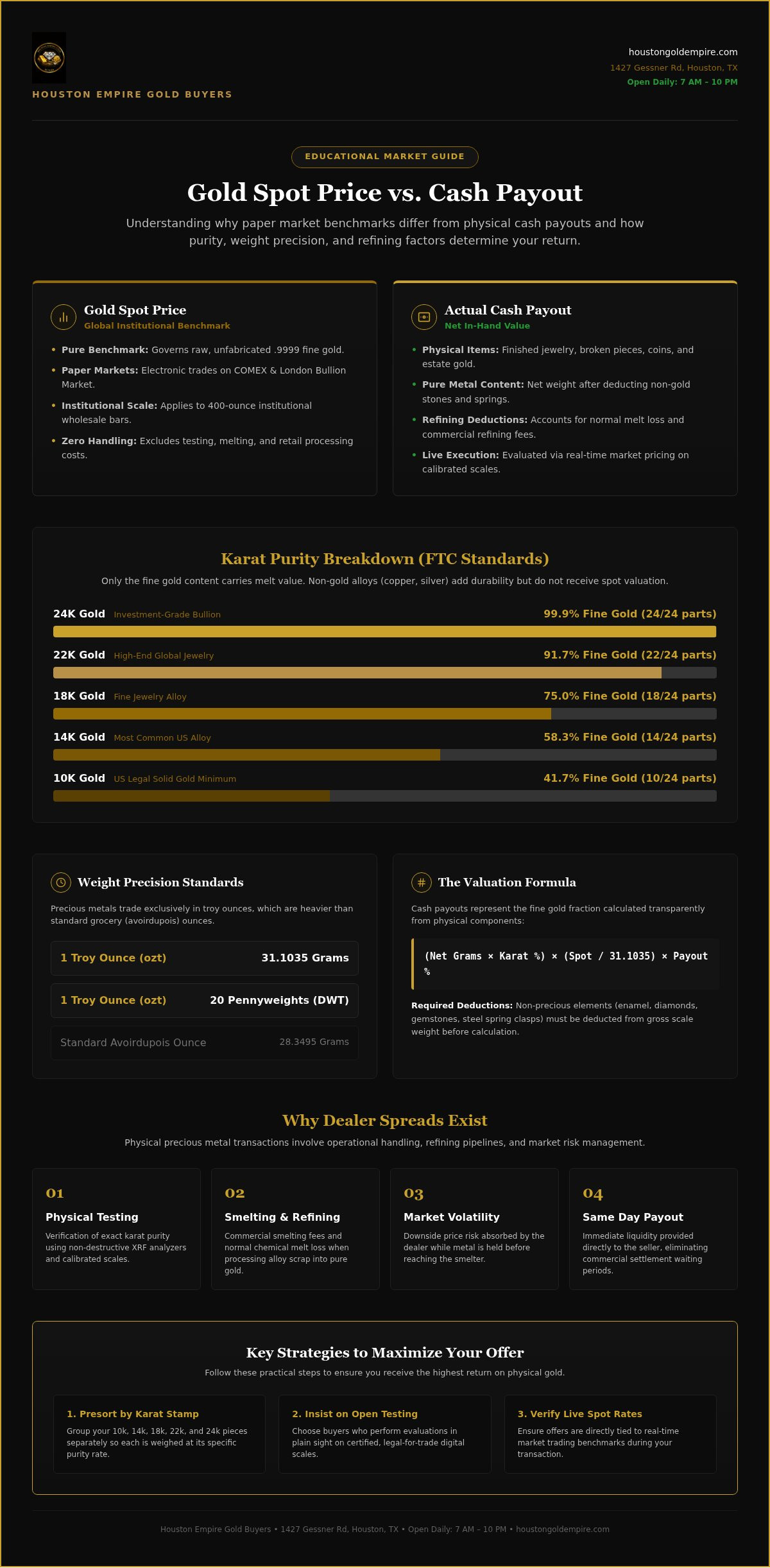
The gold spot price represents the live, wholesale benchmark for one troy ounce of raw, unfabricated .9999 fine gold. This rate governs institutional trade contracts on major mercantile exchanges, where central banks and institutional funds trade massive 400-ounce bars. In contrast, your cash payout is the net dollar amount you receive in hand for selling finished, physical items. A proper understanding of gold spot price vs payout starts by recognizing that everyday valuables, such as broken necklaces or estate rings, cannot trade at wholesale commodity figures without physical handling, testing, and processing.
How the Spot Price Is Established on Global Exchanges
Live spot prices fluctuate every second across international trading hubs like the COMEX in New York and the London Bullion Market Association. Commercial rates trace directly back to institutional trading and the historic London gold fixing benchmark, which sets global valuation standards twice daily. Because trading runs around the clock, market sentiment shifts constantly. You can review our analysis on spot price gold buyer market trends to see how daily price movements impact cash payouts in real time.
The Crucial Difference Between Paper Markets and Physical Metal
Paper gold deals with unallocated digital claims, futures contracts, and exchange-traded shares settled electronically without moving metal. Physical gold requires real-world logistics. When you bring us jewelry, bullion bars, or coins, the transaction involves physical handling. We must verify purity, weigh the metal accurately, and prepare items for the refinery. Refining, security, and holding inventory introduce practical business costs. Mastering the basics of understanding gold spot price vs payout ensures you evaluate offers based on actual metal content rather than paper market headlines.
The Core Factors Governing Your Actual Gold Payout
Calculating the true cash value of scrap or fine jewelry requires a simple mathematical formula. You multiply the pure precious metal weight by the current market rate, then apply the buyer payout percentage. Understanding gold spot price vs payout hinges on isolating the fine gold from non-precious components. Diamonds, gemstones, enamel accents, and steel clasp springs must be deducted from the gross scale weight before calculating your net payout.
Karat Purity: Measuring Pure Gold Content from 10k to 24k
Karat stamps indicate the ratio of pure gold alloyed with harder base metals. Pure gold contains 24 parts out of 24. A piece marked 14k contains 14 parts gold and 10 parts alloy, translating to 58.3% purity (0.583 fine). Federal purity rules enforced under FTC gold jewelry and karat standards mandate that stamped items clearly disclose these proportions. Consider these standard purity benchmarks:
- 10K: 41.7% pure gold (minimum legal solid gold standard in the US)
- 14K: 58.3% pure gold (most common American jewelry alloy)
- 18K: 75.0% pure gold (higher fine metal concentration)
- 22K: 91.7% pure gold (popular in high-end global jewelry)
- 24K: 99.9% pure gold (investment-grade bullion)
Alloys like copper or silver add everyday durability, but only the fine gold content carries melt value. If you plan to sell 24k gold in Houston, your payout rate approaches raw market pricing because no base metals dilute the piece.
Weight Precision: Troy Ounces vs. Standard Avoirdupois Ounces
Precious metals trade exclusively in troy ounces, not standard avoirdupois ounces used for groceries. One troy ounce equals exactly 31.1035 grams, or 20 pennyweights (DWT). In contrast, a standard household ounce weighs just 28.3495 grams. When analyzing offers, always ensure your buyer measures on legal-for-trade digital scales using troy units or grams. If you want a clear, no-pressure appraisal of your collection, stop by houstongoldempire.com to see how our calibrated testing protects your bottom line.
Why Dealer Payouts Differ from the Quoted Spot Price
Precious metal dealers do not operate as non-profit clearinghouses. Every transaction involves physical logistics, inventory risk, and operational overhead. When we purchase broken chains, dental scrap, or vintage bullion, we take on downside market risk the moment funds leave our register. Gold prices change rapidly during trading hours. If the market drops before metal reaches the smelter, the dealer absorbs that loss. Gaining a clear understanding of gold spot price vs payout helps you recognize why a standard dealer spread exists between wholesale spot and your net offer.
The Smelting and Refining Pipeline Explained
Scrap gold cannot simply be resold at investment-grade prices. It must be melted and chemically separated back into pure .999 fine gold. Refiners charge specific processing fees to handle this material:
- Thermal Smelting: High-heat induction furnaces melt down mixed alloys.
- Normal Melt Loss: Trace impurities, solder, and volatile base metals burn away during melting, slightly reducing gross weight.
- Chemical Partitioning: Acids dissolve alloy metals to isolate fine gold grains.
- Assay Verification: Specialized testing confirms the exact final yield of pure metal.
These industrial costs naturally adjust your physical cash offer below the raw commodity index.
Red Flags: Spotting Predatory Payout Practices
Legitimate operations quote offers transparently, but unscrupulous operations exploit seller confusion. Avoid mail-in services requiring you to ship valuables before receiving a firm quote. When items vanish behind closed doors, sellers lose all negotiating leverage. Be equally wary of buyers who charge arbitrary appraisal fees or refuse to disclose the live spot benchmark they use for testing. A professional buyer shares live rates openly and explains every step of the calculation.
How to Maximize Your Payout When Selling Gold in Houston
Maximizing your cash return requires proactive preparation before entering a showroom. Presort your gold jewelry by stamped karat markings, separating 10k, 14k, and 18k items into distinct bags. Never let a buyer weigh mixed karats together; low-purity pieces will drag down the valuation of higher-grade metal. Understanding gold spot price vs payout gives you the leverage to insist on transparent, in-person testing on state-certified digital scales placed right in front of you.
Non-Destructive Testing: Why XRF Spectrometry Protects You
Traditional acid scratch tests involve rubbing your jewelry against an abrasive stone, damaging intricate estate settings. Modern evaluations rely on X-ray fluorescence (XRF) technology. Read our guide on how XRF gold testing works to discover how focused X-rays analyze the exact elemental composition of your items in seconds without physical damage. XRF analysis accurately flags hidden platinum, palladium, or fine silver content in dental scrap and mixed jewelry lots, ensuring every grain of precious metal is factored into your payment.
Transparent Appraisals at Houston Empire Gold Buyers
Visit us at 1427 Gessner Rd for fast, no-obligation evaluations right here in Houston. We are open daily from 7 AM to 10 PM, and walk-ins are welcome anytime. Our certified technicians calibrate scales in plain sight and provide immediate same-day cash payouts based on live market pricing. We evaluate gold jewelry from 10k to 24k, bullion bars, coins, dental scrap, sterling silver, and platinum items without high-pressure sales tactics. Bring your collection in today, or call and text our dedicated team for clear answers to your valuation questions.
Turn Your Precious Metals into Immediate Cash Today
Navigating the secondary metal market doesn't have to be confusing. A clear understanding of gold spot price vs payout gives you full confidence when parting with your jewelry, coins, or scrap. You know that wholesale market tickers reflect raw contracts, while your cash return depends on pure weight, accurate karat content, and honest refining margins.
At Houston Empire Gold Buyers, we take the mystery out of the evaluation. We inspect your pieces openly using advanced XRF spectrometry and state-certified digital scales operated directly in your full view. Open daily from 7 AM to 10 PM with no appointment needed, our team delivers immediate same-day payouts based on live pricing.
Call or text us anytime, or visit our showroom today to turn your items into cash with complete peace of mind.
Frequently Asked Questions
Why can no gold buyer pay 100% of the live spot price?
No commercial buyer can pay full spot because the quoted ticker reflects massive, unprocessed 400-ounce wholesale bullion contracts. Finished jewelry and scrap require physical handling, transport, and refining fees to extract fine metal. Buyers also take on market volatility risk while holding metal before smelting. A clear understanding of gold spot price vs payout helps sellers realize that a modest margin covers these essential conversion costs and overhead.
How do you calculate the actual melt value of 14k gold?
Start by isolating the pure gold content using karat math. Divide 14 by 24 to determine purity, which equals roughly 58.3%. Next, weigh your item in grams on a calibrated scale and divide that number by 31.1035 to find its troy ounce weight. Multiply that troy weight by 0.5833, then multiply by the live spot price. The resulting number gives you the exact raw melt value before refining deductions.
Does the spot price apply to gold coins the same as scrap jewelry?
No, government-minted bullion coins typically yield a higher payout percentage than scrap jewelry. Items like American Gold Eagles or Canadian Maple Leafs have standardized weight and known purity, so they don't require industrial smelting to re-enter circulation. Scrap rings and necklaces require refining to burn off base alloys. When considering understanding gold spot price vs payout, remember that pure investment coins trade much closer to live market spot rates than broken jewelry.
Will acid scratch testing reduce the payout value of my gold jewelry?
Yes, traditional acid testing physically abrades your jewelry. Technicians rub the item across a coarse stone, filing away microscopic layers of gold that you don't get paid for. Strong nitric acid can also permanently discolor intricate estate designs. That's why our Houston showroom at 1427 Gessner Rd uses non-destructive XRF spectrometry instead. We scan your pieces safely in seconds, preserving their integrity while measuring exact metal purities down to the tenth of a percent.
What forms of payment do you offer for precious metal evaluations?
We provide immediate same-day cash payouts right on the spot once you accept our written offer. There are never delayed checks, processing fees, or bank clearing waits. If you prefer electronic settlement or certified payment, we can accommodate your transaction preferences smoothly. We welcome walk-in sellers daily from 7 AM to 10 PM at our Spring Branch showroom, ensuring you leave our counter with direct, guaranteed funds in hand every time.


